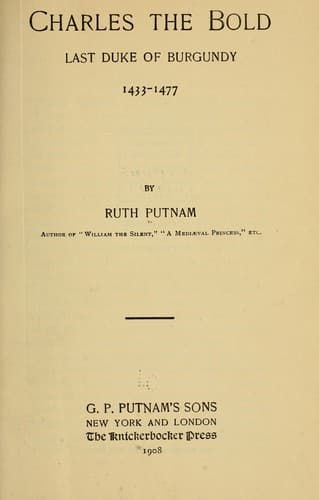
Charles the Bold, Last Duke of Burgundy, 1433-1477Putnam, Ruth
History
Charles the Bold, Last Duke of Burgundy, 1433-1477
Putnam, Ruth
Burgundy (France) -- History; Charles, Duke of Burgundy, 1433-1477; Switzerland -- History -- 1032-1499
"In order to avoid the charge of flattery, I acknowledge that he
had faults. None is perfect except God. Often he was very careless
in administration, and he neglected questions of justice, of
finance, and of commerce in a way that may redound to the injury
of his house. The excuse urged is that it was his deputies who
were at fault. The answer to that is that he trusted too much to
deputies and should not be excused for his confidence. A ruler
ought to understand his business himself.
"Also he had the vices of the flesh. He pleased his heart at the
desire of his eyes. At the desire of his heart he multiplied his
pleasures. His wishes were easy to attain. What he wanted was
offered freely. He neglected the virtuous and holy lady his wife,
a Christian saint, chaste and charitable. For this I offer no
excuse. To God I leave the cause.
"Another fault was that he was not wise in his treatment of his
nobles. Especially in his old age he often preferred the less
worthy, the less capable advisers. The answer to this charge is
that, as his health failed, whoever was by his side obtained
ascendency over him and succeeded in keeping the others at a
distance. Ergo, theirs is the malice and the excuse is to the
princely invalid. In his solitude even valets used their power, as
is not wonderful.
"He went late to mass and often out of hours. Sometimes he had
it celebrated at two o'clock or even three, and in so doing he
exceeded all Christian observance. For this there is no excuse
that I dare allege. I leave it to the judgment of God. He had,
indeed, obtained dispensation from the pope for causes which he
explained, _and he only_ is responsible. God alone can judge about
him.
"It would be a dreadful shame if his soul suffered for this
neglect in lifetime. Earth would not suffice to deplore, nor the
nature of man to lament the perdition of such a soul and of such a
prince. Hell is not worthy of him nor good enough to lodge him. 0
God, who rescued Trajan from Hades for a single virtuous act, do
not suffer this man to descend therein!"
Having thus tried his best to give a vivid description of the father's
personality, while acknowledging that he is not sure of the fate of
his soul, the chronicler decides that it would be an excellent moment
to paint the son, too, for all time, in view of his mortality. "I will
use the past tense so that my words may be good for always."
Public-domain text, read in full here on John Shaqi.
Reviews
Reviews
No reviews yet
Be the first to share your thoughts on this work.
Elsewhere in the archive
Join the Discussion
Join the discussion
Sign in to leave a comment or review.
Sign InorCreate an account