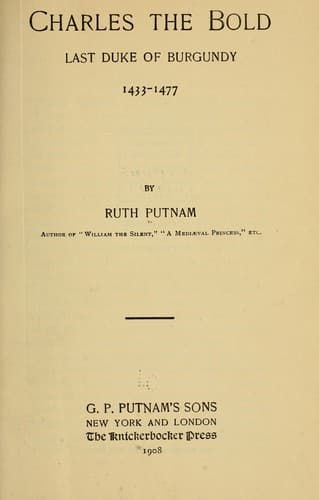
Charles the Bold, Last Duke of Burgundy, 1433-1477Putnam, Ruth
History
Charles the Bold, Last Duke of Burgundy, 1433-1477
Putnam, Ruth
Burgundy (France) -- History; Charles, Duke of Burgundy, 1433-1477; Switzerland -- History -- 1032-1499
Duke Charles was shorter and stouter than Duke Philip, but well
formed, strong in arm and thigh. His shoulders were rather thick-set
and a trifle stooping, but his body was well adapted to activity.
The contour of his face was rounder than that of his father, his
complexion brunette. His eyes were black and laughing, angelically
clear. When he was sunk in thought it seemed as though his father
looked out of them. Like his father's mouth was his, full and red. His
nose was pronounced, his beard brown, and his hair black. His forehead
was fine, his neck white and well set, though always bent as he
walked. He certainly was not as straight as Philip, but nevertheless
he was a fine prince with a fair outer man.
When he began to speak he often found difficulty in expressing
himself, but once started his speech became fluent, even eloquent.
His voice was fine and clear, but he could not sing, although he had
studied the technique and was fond of music. In conversation he was
more logical than his father, but very tenacious of his own opinion
and vehement in its expression, although, at the bottom, he was just
to all men.
In council he was keen, subtle, and ready. He listened to others'
arguments judicially and gave them due weight before his own concluded
the discussion. He was attentive to his own business to a fault, for
he was rather more industrious than became a prince. Economical of his
own time, he demanded conscience of his subordinates and worked them
very hard. He was fond of his servants and fairly affable, though
occasionally sharp in his words. His memory was long and his anger
dangerous. As a rule, good sense swayed him, but being naturally
impetuous there was often a struggle between impulse and reason.
He was a God-fearing prince, was devoted to the Virgin Mary, rigid in
his fasts, lavish in charity. He was determined to avoid death and
to hold on to his own, tooth and nail, and was his father's peer in
valour. Like his father, he dressed richly; unlike him, he cared more
for silver than for jewels. He lived more chastely than is usual to
princes and was always master of himself. He drank little wine, though
he liked it, because he found that it engendered fever in him. His
only beverage was water just coloured with wine. He was inclined to no
indulgence or wantonness. "At the hour in which I write his taste for
hard labour is excessive, but in other respects his good sense has
dominated him, at least thus far. It is to be hoped that as his reign
grows older he will curb his over-strenuous industry."
As to the duke's sympathies, Chastellain regrets that circumstances
have turned him towards England. Naturally he belonged to the French,
and it was a pity that the machinations of the king, "whose crooked
ways are well known to God, have forced him into self-defence. Yet on
his forehead he wears the fleur-de-lys."
Public-domain text, read in full here on John Shaqi.
Reviews
Reviews
No reviews yet
Be the first to share your thoughts on this work.
Elsewhere in the archive
Join the Discussion
Join the discussion
Sign in to leave a comment or review.
Sign InorCreate an account