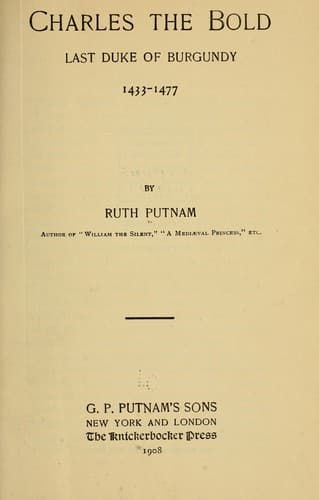
Charles the Bold, Last Duke of Burgundy, 1433-1477Putnam, Ruth
History
Charles the Bold, Last Duke of Burgundy, 1433-1477
Putnam, Ruth
Burgundy (France) -- History; Charles, Duke of Burgundy, 1433-1477; Switzerland -- History -- 1032-1499
The devotees of St. Lievin prolonged their holiday until Monday
afternoon. It was five o'clock[2] when the revellers returned to
Ghent. Many of the saint's followers were, by that time, more or less
under the influence of the contents of the casks which had formed part
of the outward-bound burden. The protracted holiday-making had its
natural sequence. There was, however, too much method in the next
proceedings for it to be attributed wholly to emotional inebriety.
The procession passed through the city gate and entered a narrow
street near the corn market, where stood a little house used as
headquarters for the collection of the _cueillotte_, a tax on every
article brought into the city for sale, and one particularly obnoxious
to the people. Suddenly a cry was raised and echoed from rank to rank
of St. Lievin's escort, "Down with the _cueillotte_."
Then with the ingenious humour of a Celtic crowd, quick to take a
fantastic advantage of a situation, a second cry was heard: "St.
Lievin must go through the house. Lievin is a saint who never turns
aside from his route."
Delightful thought, followed by speedy action. Axes were produced and
wielded to good effect.
Down came the miniature customs-house in a flash. Little pieces of
the ruin were elevated on sticks and carried by some of the rabble as
standards with the cry "I have it--I have it." As they marched
the procession was constantly augmented and the cries become more
decidedly revolutionary: "Kill, kill these craven spoilers of God and
of the world.[2] Where are they? Let us seek them out and slay them in
their houses, those who have flourished at our pitiable expense."
This was rank rebellion. Even under cover of St. Lievin's mantle,
resistance to regularly instituted customs could hardly be described
by any other name. Excited by their own temerity, the crowd now surged
on to the great market-place in front of the Hôtel de Ville, where the
Friday market is held, instead of returning the saint promptly to his
safe abiding-place as was meet.
There the lawless deeds--lawless to the duke's mind certainly--became
more audacious. Counterparts of the very banners whose prohibition
had been part of the sentence in 1453 were unfurled,[4] and their
possession alone proved insurrectionary premeditation on the part of
the gild leaders. Ghent was in open revolt, and the young duke in
their midst felt it was an open insult to him as sovereign count.
His messenger failed to return from the market-place. His master
became impatient and followed him to the scene of action with a small
escort. As they drew near, the crowd thickened and hedged them in. The
nobles became alarmed and urged the duke to return, but cries from
the crowd promised safety to his person. To the steps of the Hôtel de
Ville rode the duke, his face dark, menacing with suppressed wrath.[5]
Public-domain text, read in full here on John Shaqi.
Reviews
Reviews
No reviews yet
Be the first to share your thoughts on this work.
Elsewhere in the archive
Join the Discussion
Join the discussion
Sign in to leave a comment or review.
Sign InorCreate an account