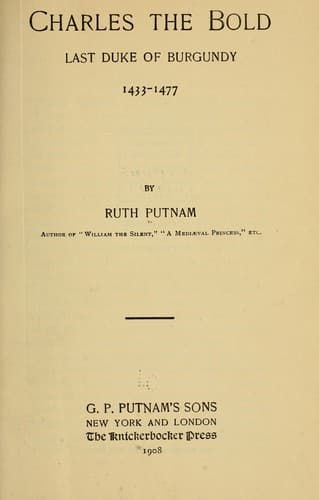
Charles the Bold, Last Duke of Burgundy, 1433-1477Putnam, Ruth
History
Charles the Bold, Last Duke of Burgundy, 1433-1477
Putnam, Ruth
Burgundy (France) -- History; Charles, Duke of Burgundy, 1433-1477; Switzerland -- History -- 1032-1499
After the dauphin was crowned at Rheims, he was monarch over all his
domains. Charles of Burgundy, on the other hand, had a series of
ceremonies to perform before he was properly invested with the various
titles worn by his father. Each duchy, countship, seigniory had to be
taken in turn. Ghent was the first capital visited. Then he had
to exchange pledges of fidelity with his Flemish subjects before
receiving recognition as Count of Flanders.
According to the custom of his predecessors, Charles stayed at the
little village of Swynaerde, near Ghent, the night before he made his
"joyous entry" into that city. It had chanced that the day selected by
Charles for the event was St. Lievin's Day and a favourite holiday of
the workers of Ghent. The saint's bones, enclosed conveniently in a
portable shrine, rested in the cathedral church, whence they were
carried once a year by the fifty-two gilds in solemn procession to
the little village of Houthem, where the blessed saint had suffered
martyrdom in the seventh century. All day and all night the saint's
devotees, the Fools of St. Lievin, as they were called, remained at
this spot. Merry did the festival become as the hours wore on, for
good cheer was carried thither as well as the sacred shrine.
Now the magistrates were a little apprehensive about the rival claims
of the new count of Flanders and the old saint of Ghent. They knew
that they could not cut short the time-honoured celebration for the
sake of the sovereign's inauguration, so they decided to prolong the
former, and directed that the saint should leave town on Saturday and
not return until Monday. This left Sunday free for the young count's
entry. It probably seemed a very convenient conjunction of events to
the city fathers, because the more turbulent portion of the citizens
was sure to follow the saint.
Accordingly, Charles made a very quiet and dignified entrance,[1]
having paused at the gates to listen to the fair words of Master
Mathys de Groothuse as he extolled the virtues of the late Count of
Flanders, and requested God to receive the present one, when he, too,
was forced to leave earth, as graciously as Ghent was receiving him
that day. All passed well; oaths of fealty were duly taken and given
at the church of St. John the Baptist. Charles himself pulled the
bell rope according to the ancient Flemish custom, and the Count of
Flanders was in possession. This all took place in the morning of June
28th. At the close of the ceremonies Charles withdrew to his hotel and
the magistrates to their dwellings.
Public-domain text, read in full here on John Shaqi.
Reviews
Reviews
No reviews yet
Be the first to share your thoughts on this work.
Elsewhere in the archive
Join the Discussion
Join the discussion
Sign in to leave a comment or review.
Sign InorCreate an account