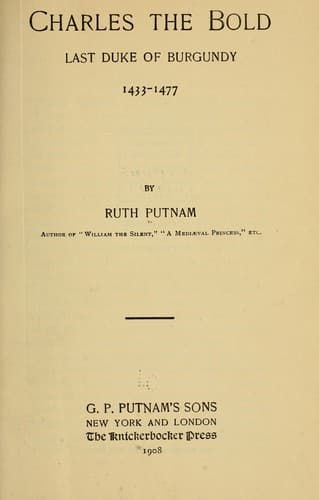
Charles the Bold, Last Duke of Burgundy, 1433-1477Putnam, Ruth
History
Charles the Bold, Last Duke of Burgundy, 1433-1477
Putnam, Ruth
Burgundy (France) -- History; Charles, Duke of Burgundy, 1433-1477; Switzerland -- History -- 1032-1499
The sober report[7] is less detailed and elaborate, but the thread is
the same. Monseigneur, having returned to his hotel, sent Monseigneur
de la Groothuse, Jean Petitpas, and Richard Utenhove back to the
market to invite the people to put their grievances in writing. A
draft was made and carried to the duke. After he had examined it and
discussed it with his council, he sent Monseigneur de la Groothuse
back to the market-place to tell the people that he wanted to sleep
on the proposition and would give his answer at an early hour on the
morrow. All through the night the people remained in arms on the
market-place. At about eight o'clock on June 30th Groothuse returned,
thanked the people in the count's name for having kept such good
watch, and was answered by cries of "_À bas la cueillotte_."
Then he assured them that all was pardoned and that they should obtain
what they had asked in the draft. Only he requested them to appoint a
committee of six to present their demands to Monseigneur and then to
go home. This they did. St. Lievin was restored to the church and his
followers betook themselves to the gates specified in the treaty of
Gaveren. These they broke down, and also destroyed another house where
was a tax collector's office.
"The report of these events carried to Monseigneur did not have a good
effect upon his spirit. On the morrow Monseigneur quitted the city."
The members of the corporation with the two deans and the popular
committee of six having obtained audience before his departure,
Groothuse acted as spokesman: "We implore you in all humility to
pardon us for the insult you have suffered, and to sign the paper
presented. The bad have had more authority than the good, which could
not be prevented, but we know truly that if the draft is not signed
they will kill us."
It is evident in all this story that the municipal authorities were
frightened to death and that Charles allowed himself to be restrained
to an extraordinary extent considering the undoubted provocation. His
reasons for conciliatory measures were two, and literally were his
ducats and his daughter. He had with him all the portable treasure and
ready money that his father had had at Bruges, a large treasure
and one on which he counted for his immediate military
operations--operations very important to the position as a European
power which he ardently desired to attain.
Still more important was the fact that his young daughter, Mary, now
eleven years old, was living in Ghent, to a certain degree the ward of
the city. If the unruly majority should realise their strength what
easier for them than to seize the treasure and hold the daughter as
hostage, until her father had acceded to every demand, and until
democracy was triumphant not only in Ghent but in the neighbouring
cities?
Public-domain text, read in full here on John Shaqi.
Reviews
Reviews
No reviews yet
Be the first to share your thoughts on this work.
Elsewhere in the archive
Join the Discussion
Join the discussion
Sign in to leave a comment or review.
Sign InorCreate an account