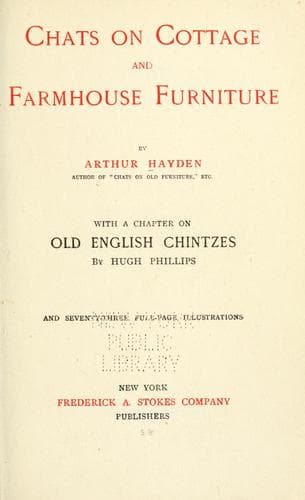
Chats on Cottage and Farmhouse FurnitureHayden, Arthur
History
Chats on Cottage and Farmhouse Furniture
Hayden, Arthur
Country furniture -- England; Furniture -- England; Textile fabrics -- England
To Staffordshire and to local potteries scattered all over the
country from Sunderland to Bristol, from Lambeth to Nottingham, from
Liverpool to Rye, one instinctively turns for real individuality and
native tradition. Similarly farmhouse furniture exhibits the work of
the local cabinet-maker in various districts, strongly marked by an
adherence to traditional forms and intensely insular in its disregard
of prevailing fashions. It is as English as the leather black-jack
and the home-brewed ale.
Contemporaneous with the great cabinet-makers who drew their
inspiration from foreign sources--from Italy, from France, from
Holland, and from Spain--small jobbing cabinet-makers in every
village and town had their patrons, and when not making wagons
or farm implements, produced furniture for everyday use. As may
readily be supposed, there is in these results a blind naïveté which
characterises a design handed down from generation to generation.
This is one of the surprising features of the village cabinet-maker's
work--its curious anachronism. The sublime indifference to passing
fashions is astonishingly delightful to the student and to the
collector.
There is nothing more uncertain than to attempt with exactitude to
place a date upon cottage or farmhouse furniture. The bacon-cupboard,
the linen-chest, the gate-table, the ladder-back chair and the
windsor chair, were made through successive generations down to
fifty years ago without departing from the original pattern of the
Charles I. or the Queen Anne period. Oak chests are found carved
with the Gothic linen-fold pattern. They might be of the sixteenth
century except for the fact that dates of the late eighteenth and
early nineteenth century are carved upon them. Whole districts
have retained similar styles for centuries, and the fondness for
clearly defined types is almost as pronounced as that of the Asiatic
rug-weaver, who makes the same patterns as his remote ancestors sold
to the ancient Greeks.
The village cabinet-maker's work knows no sequence of ages of oak,
walnut, mahogany, and satinwood. His wood is from his native trees.
His chairs come straight from the hedgerows. His history can be
spanned in one long age of oak, intermingled here and there with elm
and yew-tree and beech. The early days of primitive work go back to
the marked class distinction between gentles and simples, and the end
came only in the last decades of the nineteenth century, when the
village craftsman was obliterated by the rapid advance of factory and
machine made furniture.
Public-domain text, read in full here on John Shaqi.
Reviews
Reviews
No reviews yet
Be the first to share your thoughts on this work.
Join the Discussion
Join the discussion
Sign in to leave a comment or review.
Sign InorCreate an account