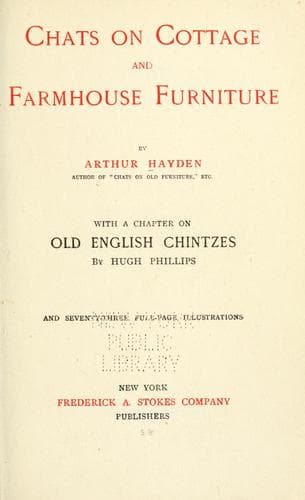
Chats on Cottage and Farmhouse FurnitureHayden, Arthur
History
Chats on Cottage and Farmhouse Furniture
Hayden, Arthur
Country furniture -- England; Furniture -- England; Textile fabrics -- England
=1690= Battle of the Boyne. William defeats James, who flees to
France.
=1691= Capitulation of Limerick; 10,000 Irish soldiers and
officers joined the service of the French King.
=1692= Battle of La Hogue, French fleet destroyed.
CHAPTER II
SEVENTEENTH-CENTURY STYLES
Typical Jacobean furniture--Solidity of English joiners'
work--Oak general in its use--The oak forests of
England--Sturdy independence of country furniture--Chests of
drawers--The slow assimilation of foreign styles--The changing
habits of the people.
To the lover of old oak, varied in character and essentially English
in its practical realisation of the exact needs of its users, the
seventeenth century provides an exceptionally fine field. The
chairs, the tables, the dower-chests and the four-post bedsteads
of the farmhouse were sturdy reflections of sumptuous furniture
made for the nobility and gentry in Jacobean and Elizabethan times.
The designs may have been suggested by finer and early models, but
the balance, the sense of proportion, and the carving, were the
result of the village carpenter's own individual ideas as to the
requirements of the furniture for use in the farmhouse. Obviously
strength and stability were important factors, and ornament, as
such, took a subsidiary place in his scheme. But, although coarse
and possessing a leaning towards the unwieldy, and often massive
without the accompanying grandeur of the highly-trained craftsman's
work, there is a breadth of treatment in such pieces which is at
once recognisable. They were made for use and no little thought was
bestowed on their lines, and, rightly appreciated, they possess
a considerable beauty. There is nothing finicking about this
seventeenth-century farmhouse furniture. There is no meaningless
ornament. Produced in conditions suitable for quiet and restrained
craftsmanship, contemplative cabinet-makers began to evolve styles
that are far removed from the average design of furniture made to-day
under more pretentious surroundings.
The gate table, with its long history and its amplification of
structure and ornament, to which a separate chapter is devoted
(Chapter III), is a case in point. It was extensively used in inns
and in farmhouses and found itself in set definite types spread
over a wide area from one end of the country to the other. Its
practicability caught the taste of lovers of utility. Its added
gracefulness of form, in combination with its adaptability to modern
needs, has recaptured the fancy of housewives to-day. It is the happy
survival of a beautiful and useful piece of ingenious cabinet-work.
Public-domain text, read in full here on John Shaqi.
Reviews
Reviews
No reviews yet
Be the first to share your thoughts on this work.
Join the Discussion
Join the discussion
Sign in to leave a comment or review.
Sign InorCreate an account