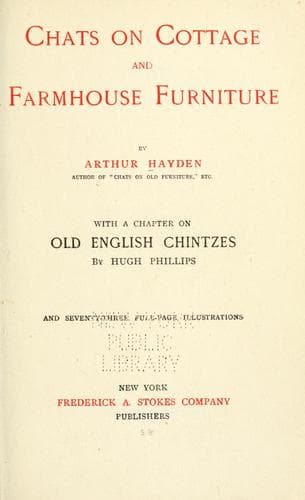
Chats on Cottage and Farmhouse Furniture — John Shaqi
Chats on Cottage and Farmhouse FurnitureHayden, Arthur
History
Chats on Cottage and Farmhouse Furniture
Hayden, Arthur
Country furniture -- England; Furniture -- England; Textile fabrics -- England
Fine example. With arcaded spandrils and gate. This is the next
stage of development to above table.
(_By the courtesy of Messrs. Phillips, Hitchin._)]
The two tables illustrated on p. 87 belong to this three-legged type.
The upper one is half circular at the top and the three legs are
stationary. This particular table is in date about 1660, and although
in this instance it is obviously later than other forms we illustrate
having gate-legs, yet by the theory we have advanced above, it
belongs to a type prior to the use of a gate. The lower one is a
fine example, in date about 1640, of a triangular gate-leg table.
The top is round, and the illustration shows the gate open at right
angles to the stretcher. The arcaded spandrils are an interesting and
rare feature.
=Transitional Types.=--Not only is the feeling towards the gradual
establishment of this new form of table shown in its construction,
first with four legs until it developed into a table with twelve
legs and double gates, but the styles of ornament used in the
turning differ greatly in character. The leg is capable of wide and
differing treatment. There is the urn leg, a rare and early type,
the ball turned leg, egg-and-reel turned leg, and the straight leg.
In regard to the stretcher similar varieties occur. Sometimes it is
entirely plain, and when it is decoratively turned it varies from
the early survival of the Gothic trestle to the rare cross stretcher
of the late collapsible table. In some types of Yorkshire tables
the stretchers are splat-form, like a ladder-back chair. The feet
differ in no less degree from the usual Jacobean type to the scroll
or Spanish foot at a later date. In the early eighteenth century
there is the interesting series of Queen Anne flap tables which
have gate-legs. Some have the bottom stretcher to the gate-leg.
These belong to the walnut period, when a greater vivacity became
noticeable in English cabinet work.
It is this picturesque and endless stream of designs which appeals to
the collector. It is quite worthy of study to follow the difference
in the cabinet-work of these gate tables. The long line of craftsmen
who fashioned them added here and there not only touches of
ornament that were personal, but invented details of construction as
improvements to existing forms.
A very early type with urn legs and having plain gates is that
illustrated p. 91. It is small in size and belongs to the first half
of the seventeenth century. The survival of the Gothic trestle feet
of an earlier type is noteworthy. The table on the same page has the
trestle ends still retained. There is still the single leg at each
end, as in the example above. The gates are square and plain and the
legs are ball turned, a combination representing an early type. The
size of this piece is small and its date is about 1650 or somewhat
later.
Public-domain text, read in full here on John Shaqi.
Reviews
Reviews
No reviews yet
Be the first to share your thoughts on this work.
Join the Discussion
Join the discussion
Sign in to leave a comment or review.
Sign InorCreate an account