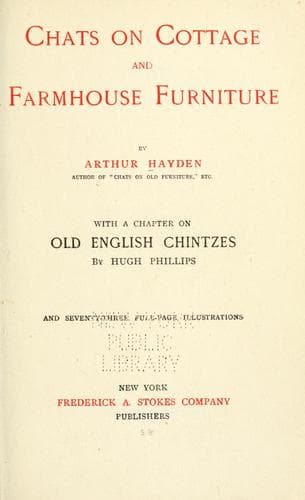
Chats on Cottage and Farmhouse FurnitureHayden, Arthur
History
Chats on Cottage and Farmhouse Furniture
Hayden, Arthur
Country furniture -- England; Furniture -- England; Textile fabrics -- England
=Its Adoption in Modern Days.=--After William Morris and his school
had preached the revival of taste and the return to the simple and
the beautiful, and Ruskin with flowing rhetoric had instilled a love
for homespun into men's minds, there came newer ideals which, with
gradual dissemination, have grown into a great modern movement which
has become so overwhelmingly popular that the pendulum has almost
swung the other way. It has now become almost a truism that the
person of taste to-day sees nothing good in anything that is not old.
With this in view, artists and persons of advanced notions, if they
could not procure the old, had copies made for them of some of the
most beautiful styles suitable for modern requirements. In this there
was always the great Morrisian principle in view that the highest art
must show a full utilitarian purpose; so it came about that the gate
table was revived and came gloriously into its own again. To-day, as
in the seventeenth century, there is no more popular form of table,
and the modern cabinet-maker is manufacturing hundreds of these
tables.
The life-history of the gate-leg table is, therefore, shown to be an
interesting one. It is one of our oldest forms, and its construction
nowadays, save that it is now produced in a factory, is singularly
similar to that in the days when Oliver Cromwell was establishing our
power as a voice in Europe, when James II. had an eye towards the
supremacy of our navy, and when later our troops fought in Flanders.
CHAPTER IV
THE FARMHOUSE DRESSER
CHAPTER IV
THE FARMHOUSE DRESSER
The days of the late Stuarts--Its early table form with
drawers--The decorated type with shelves--William and
Mary style with double cupboards--The Queen Anne cabriole
leg--Mid-eighteenth-century types.
The various types of dresser associated with farmhouse use are
interesting as being apart from the sideboard, a later fashion
belonging to furniture of a higher type. It was not until the late
days of Chippendale, and after, that the Side Table began to be
designated a Sideboard, which later became a receptacle for wine,
with a cellaret, and had a drawer for table-linen.
The sideboard is not a modern term, for the word is found in Dryden
and in Milton. In the late eighteenth-century days the sideboard had
a brass rail at the back, and was ornamented by two mahogany urns of
massive proportions. Usually these were used for iced water and for
hot water, the latter for washing the knives and forks.
The Adam sideboard with its severe classical lines, and Sheraton's
elegant bow fronts and satinwood panels decorated with painting,
belong to the later developments of the sideboard as now known.
Public-domain text, read in full here on John Shaqi.
Reviews
Reviews
No reviews yet
Be the first to share your thoughts on this work.
Join the Discussion
Join the discussion
Sign in to leave a comment or review.
Sign InorCreate an account