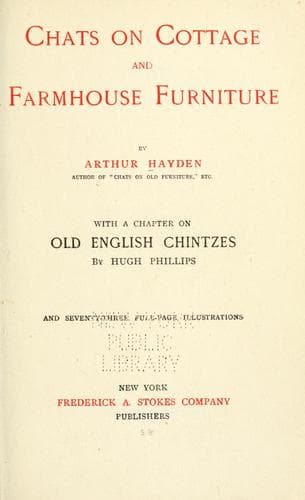
Chats on Cottage and Farmhouse FurnitureHayden, Arthur
History
Chats on Cottage and Farmhouse Furniture
Hayden, Arthur
Country furniture -- England; Furniture -- England; Textile fabrics -- England
Following the influence of Chippendale and Hepplewhite came the
style of Sheraton, which after 1790 began to affect the character of
some forms of minor furniture. That this was a very real factor is
often shown most unexpectedly in cottage and farmhouse pieces. The
satinwood and the painted panel, and the intricacies and subtleties
of his employment of colour, were of course too far removed from
the simple cabinet-work of the country maker to have the least
effect upon him, even if he ever saw them. But the slenderness and
elegance of the Sheraton styles did in a small degree have weight
with cabinet-makers as a whole in the provinces. So that it is quite
within reasonable surmise to attribute certain forms to the Sheraton
school, or rather to the oncoming of the early nineteenth-century
mannerisms. On p. 261 two examples are illustrated showing this
influence. The one with the horseshoe back is devoid of the splat,
which had now disappeared. The turned legs begin to show signs of
modernity. The other has the top-rail familiar in later forms of
cottage chair. The turned rails for the arms and the type of turning
in the legs show signs of decadence. The fine days of the old Windsor
chair were coming to an end.
[Illustration: WINDSOR CHAIR.
Horseshoe back, saddle seat, turned legs, with stretcher.
Sheraton style.]
[Illustration: WINDSOR CHAIR.
Curved top rail, turned arms, legs, and stretcher. Sheraton
style, pierced fiddle splat.]
=The Survival of the Windsor Chair Type.=--Apart from the love of
the simple form and especially well-conceived design of the Windsor
chair, which have made it at once the especial favourite of artists
and lovers of simplicity and utility, it has won the practical
approval of generations of innkeepers, who to this day store hundreds
of chairs for use at village festivals. What we have said in regard
to the popularity of the gate-leg table applies in greater degree to
the Windsor chair. The industry of turning the legs and rails of this
type of chair is still carried on in Buckinghamshire. Until recent
years much of this turning was done by hand by villagers in the
district surrounding High Wycombe, where the parts are sent to be
finished and made up. To this day some of the old chair-makers use
the antiquated pole lathe. But the chairs have departed from their
old stateliness. It is true that they have survived, almost in spite
of themselves. They are not now the objects of beauty they once were.
But they have, by reason of modern requirements, found a fresh field
of usefulness. Will it be supposed that the modern office chair is
in reality a Windsor? An examination will at once show this, even
in the latest American types. The saddle-shaped seat is there, the
straight turned legs, and the back is the same except that the upper
extension has disappeared and the old centre rail has become broader
as a properly-formed rest for the tired clerk's back. A perusal
Public-domain text, read in full here on John Shaqi.
Reviews
Reviews
No reviews yet
Be the first to share your thoughts on this work.
Elsewhere in the archive
Join the Discussion
Join the discussion
Sign in to leave a comment or review.
Sign InorCreate an account