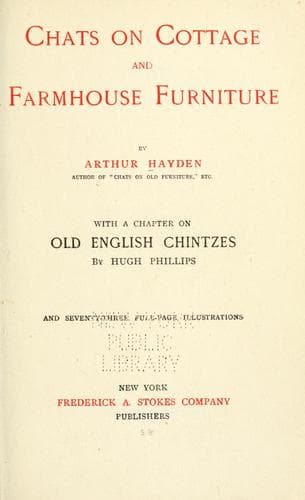
Chats on Cottage and Farmhouse FurnitureHayden, Arthur
History
Chats on Cottage and Farmhouse Furniture
Hayden, Arthur
Country furniture -- England; Furniture -- England; Textile fabrics -- England
of a few catalogues of up-to-date office furniture will establish
this. Here, then, is the last stage of the country Windsor chair.
The twentieth-century Windsor has come to town and graces the head
cashier's private office in a bank or the senior partner's room of a
firm of stockbrokers.
CHAPTER IX
LOCAL TYPES
CHAPTER IX
LOCAL TYPES
Welsh carving--Scottish types--Lancashire dressers, wardrobes,
and chairs--Hertfordshire, Bedfordshire, Cambridge, and Essex
tables--Isle of Man tables.
The charm of collecting cottage and farmhouse furniture lies
in the wide area over which it is found. Those who have given
especial attention to collecting it have learned instinctively
to differentiate between the work of various localities. Some
well-defined types of cottage furniture are only to be found in
certain counties, and nowhere else. Take for example the ladder-back
and the spindle chairs. The latter are usually found in the northern
half and the former in the southern half of England. It is obvious
that craftsmen developing on original lines, or on lines more or
less apart from outside influence, must establish designs peculiarly
identified with their field of labours.
The sturdy insularity of the British peasant, and his uneasy
reception of foreign suggestion, have had a very pronounced influence
upon his methods of work. He has the defects of his qualities, the
stern, almost uncompromising conservatism in habit of mind and in
his daily pursuits. A close study of the thoughts, and as far as
is recorded the written ideals, of the rural labouring population
exhibit an extraordinary fixity of purpose in clinging tenaciously
to old customs. The country songs more often than not express
disapproval of innovations and call up the memories of slowly
vanishing customs. The farm hands recall wistfully the old style of
Shearers' feasts and Harvest homes, when great festivities with song
and dance and old country sports enlivened the company. In Yorkshire
this was termed the Mel Supper, in Kent the Kern Supper, and in parts
of the North of England it was called the Churn Supper. Annual feasts
were given to labourers such as the Wayzgoose or Bean feast, which
later name remains to this day. The good old days is a refrain not
confined to the cottager in his relation with the farmer. The farmer,
imbued with the same wistful regard for the vanished past, bewails
the May Day tenants' feast of the eighteenth-century English squire.
We get touches of disdain for the oncoming fashion of seclusion which
invaded the farmhouse in "A Farmer's Boy," by Robert Bloomfield. He
laments that the annual feast of the harvest home had lost its former
joviality. This was written in 1798.
"The aspect only with the substance gone." Evidently the mug that
passed around was becoming a thing of the past.
"The self-same Horn is still at our command,
But serves none now but the plebeian hand."
Public-domain text, read in full here on John Shaqi.
Reviews
Reviews
No reviews yet
Be the first to share your thoughts on this work.
Elsewhere in the archive
Join the Discussion
Join the discussion
Sign in to leave a comment or review.
Sign InorCreate an account