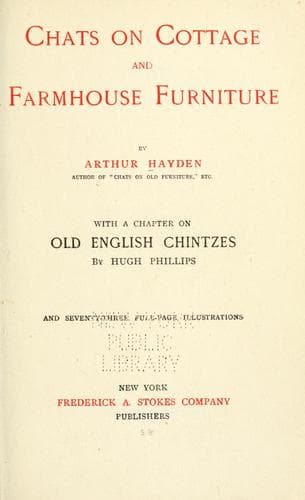
Chats on Cottage and Farmhouse FurnitureHayden, Arthur
History
Chats on Cottage and Farmhouse Furniture
Hayden, Arthur
Country furniture -- England; Furniture -- England; Textile fabrics -- England
The intense love of the Welsh woodcarver for intricacy is hardly
less than that of the sturdy Swiss craftsmen environed by mountains.
Perhaps the long winters and the solitary life influence the
development of individual character in the applied arts. The Welsh
love-spoons of wood, linked together and exhibiting delicate pierced
work and minute carving of no mean order, are among other attractive
specimens of native art. Ironwork of fine quality is also to be found
in Wales.
[Illustration: LANCASHIRE DRESSER. ABOUT 1730-1750.
Oak inlaid with mahogany.]
[Illustration: ELM WARDROBE (WELSH). ABOUT 1670.]
(_By the courtesy of Messrs. Phillips, Hitchin._)
[Illustration: FLAP-TOP TABLE.
Rare Hertfordshire Example. Diameter of top, 2 ft. 6 ins.
(_By the courtesy of Messrs. A. B. Daniell & Sons._)]
[Illustration: LANCASHIRE SPINDLE-BACK CHAIRS.]
A carved oak chest of Welsh origin, dated 1636, with Welsh
inscription on lid, is illustrated (p. 269). The table on which it
stands is of a later date. The carving in this piece is delicate
and the middle panel is typical of the representation of birds and
foliage. The Welsh cupboard on the same page typifies the coarse
woodcarving associated with Welsh farmhouse art. In style this really
belongs to a date not later than 1650. But it is dated 1710 and
bears the initials "I.S." This is an interesting example, showing
how middle-Jacobean styles lingered in country districts remote from
outside influence until the early eighteenth century.
An elm wardrobe, probably about 1670 in date, shows another type,
but still retaining the coarse character of its carving and its
well-filled panels and uprights (illustrated p. 273).
=Scottish Types.=--Scotland has antiquities of her own which are
closely allied to those of all the Gaelic races. As with Welsh
carved farmhouse furniture, there is a marked leaning towards coarse
style. As a rule it is too utilitarian in appearance to display
much carving. The spinning-wheel is still found in farmhouses, and
is still used in Harris and the outlying islands. Sometimes these
old Highland spinning-wheels come into the market with the smooth
surface worn by generations of workers, a surface impossible to
reproduce. The Scottish ironwork is especially interesting. Perhaps
the most curious of the Scottish antiquities is the crusie. This is
undoubtedly a survival of the classic oil lamp. It consists of a
shallow trough with a spout in which the wick stands, the oil being
contained in the trough (see illustration, p. 289).
Public-domain text, read in full here on John Shaqi.
Reviews
Reviews
No reviews yet
Be the first to share your thoughts on this work.
Elsewhere in the archive
Join the Discussion
Join the discussion
Sign in to leave a comment or review.
Sign InorCreate an account