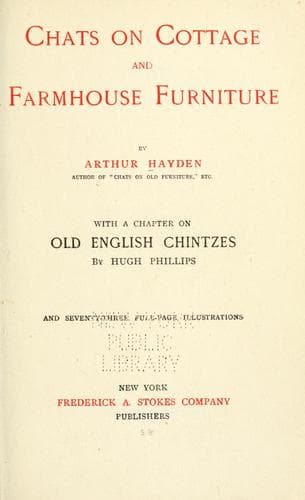
Chats on Cottage and Farmhouse FurnitureHayden, Arthur
History
Chats on Cottage and Farmhouse Furniture
Hayden, Arthur
Country furniture -- England; Furniture -- England; Textile fabrics -- England
The picture he draws of the farmer who, in face of prevailing
fashion, "yields up the custom that he dearly loves" is pathetic. The
long table and dining in common together had seemingly vanished. "The
_separate_ table and the costly bowl" touch the rustic poet's pride.
He italicises the word "separate."
[Illustration: CHEST. DATED 1636.
With Welsh inscription on lid. (Standing on table of later date.)]
[Illustration: WELSH CUPBOARD.
With typical coarse style of carving. Should be 1650 at latest.
Inscribed I.S. 1710.]
This loving regard for the past is natural at a time when the rural
population jealously feared the oncoming of the age of machinery,
which threatened to supersede many of their local industries and
finally succeeded in so doing. The obstinate adherence to old forms
was possibly part of a nervous fear of the unknown future. The
love for existing forms of furniture was therefore part of this
apprehensive retention of tradition. Not only was the resistance
of town fashions a strong feature, but local prejudices prevailed
against the adoption of designs belonging to rival counties. To
this day the Staffordshire clothes-horse, carried on pulleys to
the ceiling when not in use, differs from the clothes-horse of the
cottager in the South with no such mechanical device. In Edinburgh,
in the narrow closes, there is a kind of gallows projecting from the
windows.
These apparently minor details which find their embodiment in
articles of everyday use, fascinate and hold the attention of the
acute collector of cottage furniture.
The same local types apply to the art of the potter and are well
known to collectors. There are Sussex "tygs" and Nottingham "bears"
and Sunderland and Newcastle jugs and mugs. Bristol had its
characteristic earthenware, and the Lowestoft china factory was
strongly Suffolk in its homely inscriptions with a touch of dialect.
=Welsh Carving.=--Wales is famous for the abundance of the oak
farmhouse furniture proudly kept to this day in families who have
held the same homestead sometimes for centuries. One of the most
noticeable features is the elaboration of the carving and its
native representation, coarsely carved, without foreign influence,
of birds and beasts and heraldic monsters which largely figure
in the decorative panels of chests, and especially dressers. So
popular was oak that it might almost be advanced that there never
was any mahogany in Wales. But it is indisputable that the great
outburst in carved mahogany chairbacks coincident with the advent of
Chippendale and the publication of his _Director_, never penetrated
Wales, although it led to the foundation of a remarkable school of
woodcarving on the new lines in Ireland, known as Irish Chippendale,
a study of which can be made in Mr. Owen Wheeler's volume on old
furniture.
Public-domain text, read in full here on John Shaqi.
Reviews
Reviews
No reviews yet
Be the first to share your thoughts on this work.
Elsewhere in the archive
Join the Discussion
Join the discussion
Sign in to leave a comment or review.
Sign InorCreate an account