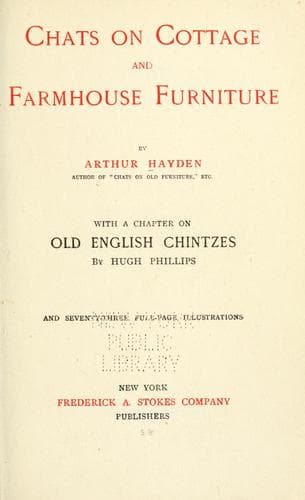
Chats on Cottage and Farmhouse FurnitureHayden, Arthur
History
Chats on Cottage and Farmhouse Furniture
Hayden, Arthur
Country furniture -- England; Furniture -- England; Textile fabrics -- England
It must be remembered that the country farmer was not familiar with
ready-made candles, and it probably no more entered his head to
purchase candles in a town than it occurred to him to do other than
bake his own bread. The cottager therefore made his candles for
himself. If he were well-to-do and could afford to entertain his
friends in modest fashion, he would doubtless like to illuminate his
table with candles of symmetrical form. In which case he would use
a candle-mould, and the wax bought in towns would serve for this
purpose. But he was not always so rich, and perhaps he was happiest
of all with the faintly glimmering rush dips which his forbears used.
These afforded a rough-and-ready form of lighting. They burned and
spluttered like a torch or flickered faintly as the tallow grew thin.
Their form closely resembled an amateur's first attempt at making a
cigarette. They were made in the following manner: the thin wirelike
rushes which grew by the water's edge were gathered and stripped of
their green surface till only the soft white pith remained. This
served as a wick. The wax was then melted over a fire in a trough or
candle-dipper, of which an illustration appears (p. 289).
Across this long receptacle the pith wicks were laid till the wax
soaked into them. They were then taken out for the wax to cool and
were dipped once or twice afterwards in order to form their outer
coating. By such a primitive process a kind of thin taper was
formed. It was not parallel along its sides, but bulged and narrowed
throughout its length in primitive manner.
[Illustration: RUSHLIGHT HOLDERS.
Showing rush fixed ready for lighting.
SCOTCH CRUSIE.
With holder.
RUSHLIGHT HOLDERS.
Showing forceps for holding
rushlight.]
[Illustration: SUFFOLK PIPE CLEANER.
The long clay "churchwarden" pipes were placed in this iron
rack and put into the fire, after which they came out perfectly
cleaned.
CANDLE-DIPPER.
(_In the collection of Messrs. Phillips, Hitchin._)]
[Illustration: QUEEN ANNE POT-HANGER.
With original grate. Same date.
(_By the courtesy of Messrs. Phillips, Hitchin._)]
[Illustration: KETTLE TRIVET.
Brass and Iron. Dated about 1770.]
Such a taper, from its uneven thickness, would naturally not
fit the socket of a candlestick, and the only receptacle would be a
scissor-like mechanism with jaws capable of clasping it at any point.
Thus we find the rushlight-holder of common use, as illustrated (p.
289).
Public-domain text, read in full here on John Shaqi.
Reviews
Reviews
No reviews yet
Be the first to share your thoughts on this work.
Elsewhere in the archive
Join the Discussion
Join the discussion
Sign in to leave a comment or review.
Sign InorCreate an account