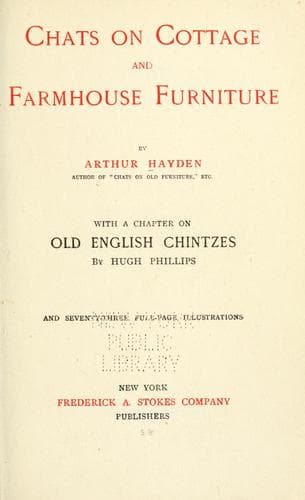
Chats on Cottage and Farmhouse FurnitureHayden, Arthur
History
Chats on Cottage and Farmhouse Furniture
Hayden, Arthur
Country furniture -- England; Furniture -- England; Textile fabrics -- England
The illustrations show two rush-holders with the rushlights affixed
in position ready for lighting, and one showing how the jaws or
forceps clip the rushlight. In practice about an inch or an inch and
a half was above the clip and the rest below. A rushlight some twelve
to fifteen inches long would burn half an hour, and it had to receive
constant attention, being pushed upwards every five minutes. But it
must be remembered that the persons who used this primitive form of
light did not use it for reading nor for a long period at a time.
They usually went to bed early after sunset.
In regard to rushlight-holders the earliest form was without the
accompanying candle-socket, but when the use of tallow dip candles
became prevalent, later forms are found, as illustrated, with the
candle-socket in addition to the holder for the rushlight.
The Scottish crusie is an iron trough of dimensions like a small
sauceboat, which was used for lighting purposes, and was often
suspended, as in the one illustrated (p. 289), from a crane or
hanger. This crusie was filled with oil and the illumination given
by a floating wick, much in the same manner as classic examples, to
which the shape bears a distant resemblance.
The firedogs were always simple, doubtless the product of the local
blacksmith. Where they had hooks along the backs they held crossbars
to prevent the logs falling into the room. The dates of these, as
of all cottage ironwork, are almost impossible to fix, owing to the
survival of the earlier types even so late as the middle of the
nineteenth century.
=The Chimney Crane.=--A most important part of the cottager's
fireplace was his chimney crane. These were of two kinds, the
pot-hook and the swing-arm variety. The pot-hook hung in the chimney
from a chain, and from its teeth was fixed a catch which might be
lowered or raised to keep the cauldron at a level with the flames.
The swing-arm type is more elaborate, and was made to fit very large
fireplaces, where the fire might not invariably be in the same spot
on the hearth. This type was used in the kitchens of the better
farmhouses. Its end was fixed to the wall of the hearth, and the pot
could be swung backwards and forwards and sideways, besides being
raised or lowered to the fire.
The pot-hook is of great antiquity, and belongs to days when man
first learned to cook his food. Frequently in this country early
examples are dug up. There are fine specimens to be seen of the late
Celtic period at the Owens College Museum, at the Northampton Museum,
at the Liverpool Museum, at the Pitt Rivers Museum at Farnham, at the
Victoria and Albert Museum, and elsewhere.
"Pot-hooks and hangers" is an English phrase denoting the beginning
of things academic, and the French phrase _pendre la crémaillère_
(literally to hang the pot-hook) is used to-day in reference to what
we term a "house-warming" party on settling in a new abode.
Public-domain text, read in full here on John Shaqi.
Reviews
Reviews
No reviews yet
Be the first to share your thoughts on this work.
Elsewhere in the archive
Join the Discussion
Join the discussion
Sign in to leave a comment or review.
Sign InorCreate an account