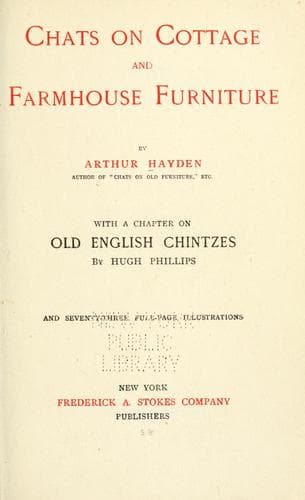
Chats on Cottage and Farmhouse FurnitureHayden, Arthur
History
Chats on Cottage and Farmhouse Furniture
Hayden, Arthur
Country furniture -- England; Furniture -- England; Textile fabrics -- England
These country grandfather clocks are much treasured by their owners,
and have been handed down in families for generations. Owing to the
indefatigability of collectors and their persistent and tempting
offers, many have left their old homes. The demand has been great,
and thousands of "grandfather" clocks have been made during the last
twenty years and sold as "antique," or old cases with plain panels
have received the unwelcome attention of the modern restorer and have
been carved to please a popular whim for carved oak panels.
In regard to dates of grandfather clocks the records of the
Clockmakers' Company give a list of makers of the eighteenth century,
enabling the period to be fairly accurately fixed. The walnut
cases inlaid with floral marquetry, often attributed to the period
1690-1725, that is William and Mary and Queen Anne, frequently belong
to a quarter of a century later. The case-makers clung more closely
to old designs than did the clockmakers. Hence the case very often
is of apparently older style than the works, though both were made
contemporaneously. In addition to this, new clocks were put in older
cases, or _vice versa_, which, like putting new pictures in old
frames, adds to the gaiety of collecting.
In general the London clock-cases are only roughly indicative, in
comparison with the Company records, of contemporary styles of
furniture. In country-made pieces the wood cases are anything from
twenty to forty years behind London fashions. For example, the arched
top occurs after 1720 in London, and after 1735 in the provinces. In
the _Director_ of Chippendale and in Sheraton's and Hepplewhite's
books of designs there are illustrations of clock cases. The
progression of styles of eighteenth-century grandfather clock cases
is from plain oak to figured walnut, black and red lacquer, floral,
"seaweed," or mosaic marquetry, and in the latter decades of the
eighteenth century inlaid mahogany cases, and many of these have
finely veneered panels. In many country clocks oak cases are veneered
in mahogany, but as a rule country made grandfather cases are plain
oak. The example illustrated (p. 307) indicates the plain type of
solidly made provincial piece. The clock was made by J. Paxton at St.
Neots.
The mahogany-cased grandfather clock is never found in cottages.
There are no Chippendale styles in this field for the collector to
search for. The plainness of the country style has happily in many
instances preserved them from alien hands. An interesting revival,
chiefly on account of expense, is found in the Dutch clock, with
china face painted with flowers, which the cottager bought in early
and middle nineteenth-century days. This form of clock reverted to
the unprotected pendulum and weights, and is an object-lesson in what
the style of English clock was before the use of a long wooden case.
But these Dutch clocks are interesting rather than valuable, and have
not yet claimed the attention of collectors.
CHAPTER XI
Public-domain text, read in full here on John Shaqi.
Reviews
Reviews
No reviews yet
Be the first to share your thoughts on this work.
Elsewhere in the archive
Join the Discussion
Join the discussion
Sign in to leave a comment or review.
Sign InorCreate an account