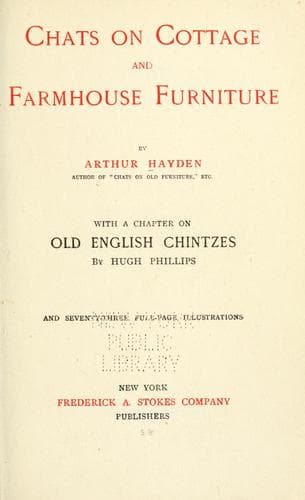
Chats on Cottage and Farmhouse FurnitureHayden, Arthur
History
Chats on Cottage and Farmhouse Furniture
Hayden, Arthur
Country furniture -- England; Furniture -- England; Textile fabrics -- England
OLD ENGLISH CHINTZES
CHAPTER XI
OLD ENGLISH CHINTZES
BY HUGH PHILLIPS
The charm of old English chintz--Huguenot cloth-printers settle
in England--Jacob Stampe at the sign of the Calico Printer--The
Queen Anne period--The Chippendale period--The age of machinery.
The present chapter has been added with perhaps some justification,
since it seemed to the writer that such a subject as old English
chintzes might appropriately take its place beside the equally homely
craft of the rural cabinet-maker.
For the chintz is the _tapisserie d'aubusson_ of the peasant--it
covers his chairs and drapes his windows, giving warmth and wealth of
colour to the otherwise barren appearance of his cottage. Further,
it reflects his simple horticultural tastes, for the brilliantly
coloured roses, pansies, and convolvuluses which shine prominently on
the glazed surface of the cloth are those flowers which are always to
be found in his garden.
Chintz or printed cotton is the only decorative fabric known to the
village upholsterer. When persons of wealth hung their windows with
silk brocades and covered their chairs with costly needlework and
damasks, the rural cabinet-maker was supplying his modest _clientèle_
with these homely patterns printed upon common cloth.
These unassuming fabrics were as much cherished by the cottagers as
anything which they possessed. The classical ornament of expensive
silks they did not understand, and the freely treated birds and
flowers which figured on chintz represented the Alpha and Omega of
beauty in textile design.
So great, indeed, is the fascination of these for the cottagers that
to-day, in districts less penetrated by modern advance, the rural
populace will not extend their affections to the up-to-date designs
of upholsterers, but insist upon the old spot and sprig patterns of
their ancestors.
There is much wisdom in the conservative taste of the peasant, for
the old chintz of the eighteenth and early nineteenth centuries was
of the highest artistic merit. In the heyday of its fame the fabric
was exceedingly fashionable amongst the richest persons, and there
are abundant records of the popularity of old English chintzes upon
the Continent. For, at its best periods, the chintz was not a base
imitation of more expensive fabrics; it did not, for instance,
occupy the relationship of pewter to silver or moulded composition
to genuine woodcarving. On the contrary, the designing of chintzes
is an art of distinction, governed by canons which bear little
relationship to other decorative textile crafts. For where the
silk-weaver is confined to solid patterns which will appear in his
transverse threads, the printer of cloths can wander unrestrained
into designs of wonderful intricacy and beauty: every colour in
nature he can imitate, and no object is too delicate or too rich to
stamp upon his cotton. Indeed, his art stops little short of that of
the painter of pictures.
Public-domain text, read in full here on John Shaqi.
Reviews
Reviews
No reviews yet
Be the first to share your thoughts on this work.
Elsewhere in the archive
Join the Discussion
Join the discussion
Sign in to leave a comment or review.
Sign InorCreate an account