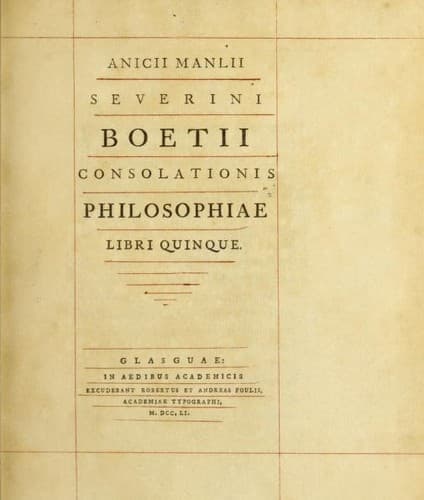
Chaucer's Translation of Boethius's "De Consolatione Philosophiae"Boethius
ReligionComparative
Chaucer's Translation of Boethius's "De Consolatione Philosophiae"
Boethius
Happiness; Philosophy and religion
¶ But wiþ how grete harmes þise *forseide weyes
ben enlaced. ¶ I shal shewe þe shortly.
[Sidenote: Do you want to amass wealth, then you must take it from
your neighbours.]
¶ For whi
yif þou enforcest þe to assemble moneye. þou most by-reuen 2208
hym his moneye þat haþ it.
[Sidenote: Would you shine in dignities, then you must beg for
them and disgrace yourself by a humiliating supplication.]
and yif þou wilt
shynen wiþ dignites. þou most bysechen {and} supplien
hem þat ȝiue{n} þo dignitees. ¶ And yif þou coueitest
by hono{ur} to gon by-fore oþer folk þ{o}u shalt defoule þi 2212
self by hu{m}blesse of axing.
[Sidenote: If power be your ambition, you expose yourself to the
snares of inferiors.]
yif þou desiryst power.
þou shalt by awaites of þi subgitȝ anoyously be cast
vndir many p{er}iles.
[Sidenote: Do you ask for glory, to be distracted by vexations and
so lose all security.]
axest þou glorie þ{o}u shalt ben so
destrat by aspre þinges þat þou shalt forgone sykernesse. 2216
[Sidenote: Do you prefer a voluptuous life? Think then that all
men will despise him who is a thrall to his body.]
¶ And yif þou wilt leden þi lijf in delices.
euery whiȝt shal dispisen þe {and} forleten þe as þou þat
art þral to þing þat is ryȝt foule {and} brutel. þat is [to]
sein seruau{n}t to þi body.
[Sidenote: They build upon a weak foundation that place bodily
delights above their own reason.]
¶ Now is it þan wel yseen 2220
how lytel {and} how brutel possessiou{n} þei coueiten þat
putten þe goodes of þe body abouen hire owe{n} resou{n}.
[Sidenote: Can you surpass the elephant in bulk, or the bull in
strength?]
¶ For mayst þou so{ur}mou{n}te{n} þise olifuñtȝ in gretnesse
or weyȝt of body. Or mayst þou ben strenger þan þe 2224
bole.
[Sidenote: Art thou swifter than the tiger?]
Mayst þou ben swifter þan þe tigre.
[Sidenote: Behold the immense extent of the heavens and cease to
admire vile or lesser things.]
biholde þe
spaces {and} þe stablenesse {and} þe swyfte cours of þe [[pg 81]]
heuene. {and} stynte somtyme to wondren on foule
þinges.
[Sidenote: Admire what is still more admirable, the consummate
wisdom that governs them.]
þe whiche heuene certys nis nat raþer for þise 2228
þinges to ben wondred vpon. þan for þe resou{n} by
whiche it is gouerned.
[Sidenote: How fleeting is beauty!]
but þe shynynge of þi forme þat
is to seien þe beaute of þi body. how swiftly passyng is
it {and} how transitorie.
[Sidenote: It fades sooner than the vernal flowers.]
¶ Certis it is more flittynge 2232
þan þe mutabilite of floures of þe som{er} sesou{n}.
Public-domain text, read in full here on John Shaqi.
Reviews
Reviews
No reviews yet
Be the first to share your thoughts on this work.
Elsewhere in the archive
Join the Discussion
Join the discussion
Sign in to leave a comment or review.
Sign InorCreate an account