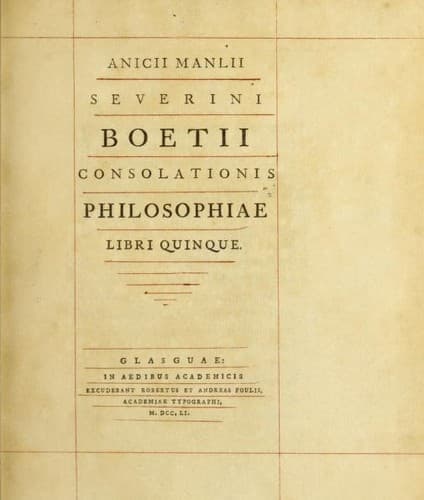
Chaucer's Translation of Boethius's "De Consolatione Philosophiae"Boethius
ReligionComparative
Chaucer's Translation of Boethius's "De Consolatione Philosophiae"
Boethius
Happiness; Philosophy and religion
[Sidenote: _B._ No sane man can think so.]
No man q{uo}d .I. but yif he be out of hys witte.
[Sidenote: _P._ But men may do evil.]
¶ but 3332
certys sherewes mowen doñ yuel q{uo}d she.
[Sidenote: _B._ I would to God they could not.]
¶ ȝe wolde
god q{uo}d I þat þei ne myȝte{n} don none.
[Sidenote: _P._ Since he that can do good, can do all things, and
he that has power to do evil cannot do all things, therefore the
evil-doers are less powerful.]
þat q{uo}d she
so as he þat is myȝty to done oonly but good[e] þinges
may don alle þinges. and þei þat ben myȝty to done 3336
yuel[e] þinges ne mowen nat alle þinges. þan is þis open
þing {and} manifest þat þei þ{a}t mowe{n} don yuel ben of
lasse power.
[Sidenote: Let me add too that _power_ is one of the things to be
desired, and that all such things are to be referred to the chief
good (the perfection of their nature).]
and ȝitte to p{ro}ue þis conclusiou{n} þere
helpeþ me þis þat I haue shewed here byforne. þat al 3340
power is to be nou{m}bred amonge þinges þat men auȝten
requere. {and} haue shewed þat alle þi{n}ges þat auȝten ben
desired ben referred to good ryȝt as to a manere heyȝte
of hyr nature.
[Sidenote: But the power of doing evil has no relation to that
Good, therefore it is not desirable; but as all power is
desirable, it is clear that the ability to do evil is not power.]
¶ But for to mowen don yuel {and} 3344
felonye ne may nat ben referred to good. þan nis nat
yuel of þe nou{m}bre of þinges þat auȝte{n}.
[Sidenote: [* fol. 26 _b_.]]
*be desired. but
al power auȝt[e] ben desired {and} requered. ¶ þan is
it open {and} cler þat þe power ne þe moeuyng of shrewes 3348
nis no powere.
[Sidenote: It clearly follows from this reasoning, that the good
only are powerful while the vicious are feeble.]
{and} of alle þise þinges it sheweþ wel þat
þe goode folk ben certeynly myȝty. {and} þe shrewes ben [[pg 118]]
douteles vnmyȝty
[Sidenote: And Plato’s opinion is hereby verified that the _wise_
only have the power to do what they desire; the wicked may follow
the dictates of their lusts, but their great aim and desire,
_i. e._ HAPPINESS, they can never attain.]
¶ And it is clere {and} open þat þilke
sentence of plato is uerray {and} soþe. þ{a}t seyþ þat oonly 3352
wiseme{n} may [doon] þat þei desiren. {and} shrewes
mowen haunten þat hem lykeþ. but þat þei desiren þat
is to seyne to comen to souereyne good þei ne han no
power to acomplissen þat.
[Sidenote: The wicked may gratify their desires, thinking to
attain the chief good (for which they wish), but they can never
possess it, for impiety and vice can never be crowned with
happiness.]
Public-domain text, read in full here on John Shaqi.
Reviews
Reviews
No reviews yet
Be the first to share your thoughts on this work.
Elsewhere in the archive
Join the Discussion
Join the discussion
Sign in to leave a comment or review.
Sign InorCreate an account