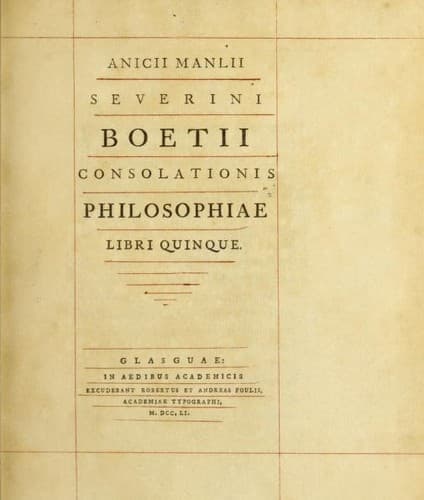
Chaucer's Translation of Boethius's "De Consolatione Philosophiae"Boethius
ReligionComparative
Chaucer's Translation of Boethius's "De Consolatione Philosophiae"
Boethius
Happiness; Philosophy and religion
¶ Haue we nat graunted þan q{uo}d she þat
good[e] folk ben blysful. {and} shrewes ben wrecches.
[Sidenote: _B._ Yes.]
ȝis q{uo}d I.
[Sidenote: _P._ If good be added to the wretchedness of a man,
will not he be happier than another whose misery has no element of
good in it?]
[thanne q{uod} she] ȝif þat any good were 3592
added to þe wrecchenesse of any wyȝt. nis he nat more
blisful þan he þat ne haþ no medelyng of goode in hys
solitarie wrecchednesse.
[Sidenote: _B._ It seems so.]
so semeþ it q{uo}d I.
[Sidenote: _P._ And if to the same wretched being another misery
be annexed, does not he become more wretched than he whose misery
is alleviated by the participation of some good?]
and what
seyst þou þan q{uo}d she of þilke wrecche þat lakkeþ alle 3596
goodes. so þat no goode nis medeled in hys wrecchednesse.
{and} ȝitte ouer alle hys wickednesse for whiche
he is a wrecche þat þer be ȝitte anoþer yuel anexid {and}
knyt to hym. shal not men demen hym more vnsely 3600
þan þilke wrecche of whiche þe vnselynesse is re[le]ued
by þe p{ar}ticipac{i}ou{n} of som goode.
[Sidenote: _B._ He does.]
whi sholde he nat
q{uo}d I.
[Sidenote: _P._ When evil men are punished they have a degree of
good annexed to their wretchedness, to wit, the punishment itself,
which as it is the effect of justice is good.]
¶ þan certys q{uo}d she han shrewes whan þei
ben punissed somwhat of good anexid to hir wrecchednesse. 3604
þat is to seyne þe same peyne þat þei suffren
whiche þat is good by þe resou{n} of Iustice.
[Sidenote: And when these wretches escape punishment something
more of ill (_i. e._ exemption from punishment) is added to their
condition.]
And whan
þilke same shrewes ascapen wiþ outen tourment. þan
han þei somwhat more of yuel ȝit ouer þe wickednesse 3608
þat þei han don. þat is to seye defaute of peyne.
whiche defaute of peyne þou hast graunted is yuel.
[Sidenote: _B._ I cannot deny it.]
¶ For þe desert of felonye I ne may nat denye it q{uo}d I.
[Sidenote: _P._ Much more unhappy are the wicked when they enjoy
an unmerited impunity than when they suffer a lawful
chastisement.]
¶ Moche more þan q{uo}d she ben shrewes vnsely 3612
whan þei ben wrongfully delyuered fro peyne. þan
whan þei beþ punissed by ryȝtful vengeaunce.
[Sidenote: It is just to punish evil-doers, and unjust that they
should escape punishment.]
but þis is
open þi{n}g {and} clere þat it is ryȝt þat shrewes ben
punissed. {and} it is wickednesse {and} wrong þat þei 3616
escapin vnpunissed.
[Sidenote: _B._ Nobody denies that.]
[Sidenote: [* fol. 28 _b_.]]
¶ who myȝt[e] denye *þat q{uo}d I.
Public-domain text, read in full here on John Shaqi.
Reviews
Reviews
No reviews yet
Be the first to share your thoughts on this work.
Elsewhere in the archive
Join the Discussion
Join the discussion
Sign in to leave a comment or review.
Sign InorCreate an account