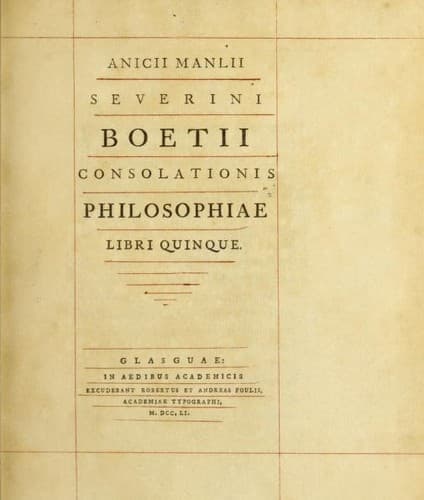
Chaucer's Translation of Boethius's "De Consolatione Philosophiae"Boethius
ReligionComparative
Chaucer's Translation of Boethius's "De Consolatione Philosophiae"
Boethius
Happiness; Philosophy and religion
[Sidenote: _P._ Everything, too, which is just is good; and, on
the contrary, whatsoever is unjust is evil.]
but q{uo}d she may any ma{n} denye. þat al þat is ryȝt nis
good. {and} also þe contrarie. þat alle þat is wrong nis
wicked. [[pg 127]]
[Sidenote: _B._ These are just inferences from our former
premises.]
certys q{uo}d I þise þinges ben clere ynouȝ. {and} 3620
þat we han concludid a litel here byforn{e}.
[Sidenote: But is there any punishment for the soul after death of
the body?]
but I p{re}ye
þe þat þou telle me yif þou accordest to leten no to{ur}ment
to þe soules aftir þat þe body is dedid by þe deþe.
þis [is] to seyn. vndirstondest þou ouȝt þat soules han 3624
any to{ur}ment after þe deþe of þe body.
[Sidenote: _P._ Yes, and great ones too. Some punishments are
rigorous and eternal.]
¶ Certis q{uo}d
she ȝe {and} þat ryȝt grete. of whiche soules q{uo}d she I
trowe þat so{m}me ben to{ur}mentid by asprenesse of
peyne.
[Sidenote: Others have a corrective and purifying force, and are
of finite duration.]
{and} so{m}me soules I trowe be exc{er}cised by a 3628
p{ur}ging mekenesse.
[Sidenote: But this is not to our purpose.]
but my conseil nys nat to determyne
of þis peyne. but I haue trauayled and told it
hider to.
[Sidenote: I want you to see that the power of the wicked is in
reality nothing, that the wicked never go unpunished; that their
licence to do evil is not of long duration, and that the wicked
would be more unhappy if it were longer, and infinitely wretched
if it were to continue for ever.]
¶ For þou sholdest knowe þat þe mowynge
[.i. myght] of shrewes whiche mowynge þe semeþ to 3632
ben. vnworþi nis no mowynge. {and} eke of shrewes of
whiche þou pleynedest þat þei ne were nat punissed.
þat þou woldest seen þat þei ne weren neuer mo wiþ
outen þe torment of hire wickednesse. {and} of þe licence 3636
of mowynge to done yuel. þat þou p{re}idest þat it
myȝt[e] sone ben endid. {and} þat þou woldest fayne
lerne. þat it ne sholde nat longe endure. {and} þat
shrewes ben more vnsely yif þei were of lenger duryng. 3640
{and} most vnsely yif þei weren p{er}durable.
[Sidenote: After this I showed that evil men are more unhappy,
having escaped punishment, than if justly chastised.]
{and} after
þis I haue shewed þe þat more vnsely ben shrewes
whan þei escapen wiþ oute ryȝtful peyne. þan whan þei
ben punissed by ryȝtful uengeaunce.
[Sidenote: Wherefore when they are supposed to get off scot-free
they suffer most grievously.]
Public-domain text, read in full here on John Shaqi.
Reviews
Reviews
No reviews yet
Be the first to share your thoughts on this work.
Elsewhere in the archive
Join the Discussion
Join the discussion
Sign in to leave a comment or review.
Sign InorCreate an account