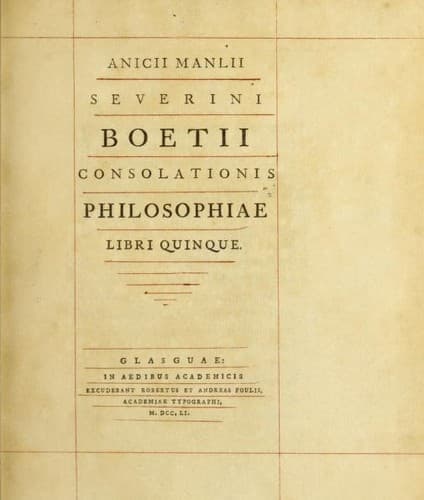
Chaucer's Translation of Boethius's "De Consolatione Philosophiae"Boethius
ReligionComparative
Chaucer's Translation of Boethius's "De Consolatione Philosophiae"
Boethius
Happiness; Philosophy and religion
[Sidenote: If God from eternity doth foreknow not only the works,
but the designs and wills of men, there can be no liberty of
will--nor can there be any other action or will than that which a
Divine and infallible Providence hath foreseen.]
¶ For whiche yif þat god
knoweþ by-forn nat oonly þe werkes of men. but also
hir conseils {and} hir willes. þan ne shal þer be no 4448
liberte of arbitre. ne certys þer ne may ben noon oþer
dede ne no wille but þilke whiche þe deuyne purueaunce
þat ne may nat ben desseiued haþ feled byforn
[Sidenote: For if things fall out contrary to such foreseeing, and
are wrested another way, the prescience of God in regard to
futurity would not be sure and unerring--it would be nothing but
an uncertain opinion of them: but I take it to be impious and
unlawful to believe this of God.]
¶ For
yif þat þei myȝten wryþen awey in oþer manere þan þei 4452
ben purueyed. þan ne sholde þer ben no stedfast p{re}science
of þinge to comen but raþer an vncerteyn
oppiniou{n}. þe whiche þinge to trowen on god I deme it
felonie {and} vnleueful.
[Sidenote: Nor do I approve of the reasoning made use of by some.
For they say that a thing is not necessarily to happen because God
hath foreseen it, but rather because it is to happen it cannot be
hid from the divine Providence.]
¶ Ne I ne proeue nat þilk 4456
same resou{n}. as who seiþ I ne allowe nat. or I ne p{re}ise
nat þilke same resou{n} by whiche þat som men wenen
þat þei mowen assoilen {and} vnknytten þe knot of þis
questiou{n}. ¶ For certys þei seyn þ{a}t þing nis nat to 4460
come for þat þe purueaunce of god haþ seyn it byforn{e}.
þat is to comen but raþer þe cont{ra}rie. ¶ And þat
is þis þat for þat þe þing is to comen þat þerfore
ne may it nat ben hyd fro þe purueaunce of god. 4464
[Sidenote: [* fol. 35.]]
[Sidenote: Now by this reason necessity appears to change sides.
For it is not necessary that the things which are foreseen should
happen, but it is necessary that the things which are to befall
should be foreseen.]
*{and} in þis manere þis necessite slydiþ aȝein in to þe [[pg 155]]
contrarie p{ar}tie. ne it ne byhoueþ [nat] nedes þat þinges
bytiden þat ben ypurueid. [but it by-houeth nedes /
þ{a}t thinges þ{a}t ben to comyn ben yporueyid] but as it 4468
were yt{ra}uailed.
[Sidenote: As if the question was, which was the cause of the
other--_prescience_ the cause of the necessity of future events,
or the _necessity_ the cause of the prescience of future events?]
Public-domain text, read in full here on John Shaqi.
Reviews
Reviews
No reviews yet
Be the first to share your thoughts on this work.
Elsewhere in the archive
Join the Discussion
Join the discussion
Sign in to leave a comment or review.
Sign InorCreate an account