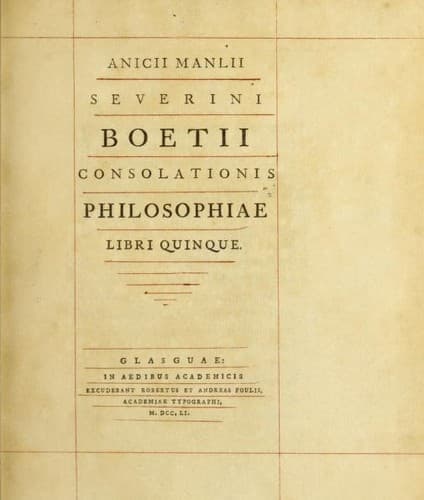
Chaucer's Translation of Boethius's "De Consolatione Philosophiae"Boethius
ReligionComparative
Chaucer's Translation of Boethius's "De Consolatione Philosophiae"
Boethius
Happiness; Philosophy and religion
[[pg 168]]
[Headnote:
INTELLIGENCE A DIVINE ATTRIBUTE.]
Q{UO}D SI IN CORPORIB{US} SENCIEND{IS}.
[Sidenote: [* fol. 38.]]
*QUESTIO.
[Sidenote: [The .5.^the p{ro}se.]]
[Sidenote: Although there are in objects certain qualities which
strike externally upon the senses, and put their instruments in
motion; although the passive impression upon the body precedes the
action of the mind,]
++But what [yif] þat in bodies to be{n} feelid þat is
to sein in þe takynge of knowelechinge of bodyly
þinges. and al be it so þat þe qualites of bodies þ{a}t ben 4875
obiect fro wiþ oute forþe moeuen {and} entalenten þe instrumentes
of þe wittes.
[Sidenote: and although the former rouses the latter to action,
yet if in the perception of bodily things, the soul is not by the
impression of external things made to know these things, but by
its own power judgeth of these bodily impressions,]
and al be it so þat þe passiou{n}
of þe body þat is to seyn þe witte [or the] suffrau{n}ce
[goth to-forn the strengthe of the workynge corage / the
which passiou{n} or suffraunce] clepiþ furþe þe dede of 4880
þe þouȝt in hym self. {and} moeueþ {and} exiteþ in þis
mene while þe formes þ{a}t resten wiþ in forþe. and yif
þat i{n} sensible bodies as I haue seid oure corage nis nat
ytauȝt or enp{re}ntid by passiou{n} to knowe þise þinges. 4884
but demiþ {and} knoweþ of hys owen strengþe þe passiou{n}
or suffrau{n}ce subiect to þe body.
[Sidenote: how much more shall those pure spiritual beings (as God
or angels) discern things by an act of their understanding alone,
without the aid of impressions from external objects?]
Moche more þan þoo
þinges þat ben absolut {and} quit fram alle talentȝ or
affecc{i}ou{n}s of bodies. as god or hys aungels ne folwen 4888
nat in discernynge þinges obiect from wiþ oute forþe.
but þei accomplissen {and} speden þe dede of hir þouȝt
[Sidenote: For this reason, then, there are several sorts of
knowing distributed among various beings.]
by þis resou{n}.
¶ þan þere comen many manere knowynges
to dyu{er}se {and} differy{n}g substaunces.
[Sidenote: For sense (or sensation) destitute of all other
knowledge is allotted to those creatures that have no motion, as
shell-fish.]
for þe wit 4892
of þe body þe whiche witte is naked {and} despoyled of
alle oþer knowynges. þilke witte comeþ to bestes þat ne
mowen nat moeuen hem self here ne þere. as oystres
{and} muscles {and} oþer swiche shelle fysshe of þe see. 4896
þ{a}t cliue{n} {and} ben norissed to roches.
[Sidenote: But imagination is given to such brutes capable of
motion, and having in some degree the power of desiring or
refusing.]
Public-domain text, read in full here on John Shaqi.
Reviews
Reviews
No reviews yet
Be the first to share your thoughts on this work.
Elsewhere in the archive
Join the Discussion
Join the discussion
Sign in to leave a comment or review.
Sign InorCreate an account