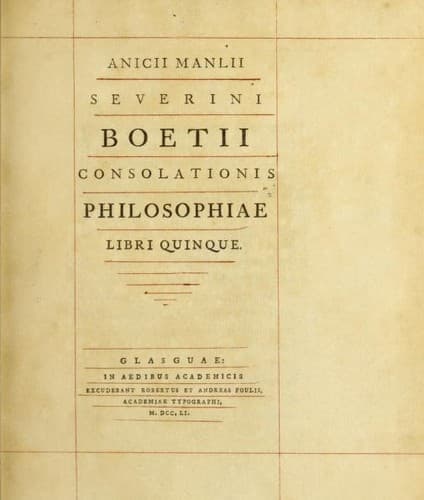
Chaucer's Translation of Boethius's "De Consolatione Philosophiae"Boethius
ReligionComparative
Chaucer's Translation of Boethius's "De Consolatione Philosophiae"
Boethius
Happiness; Philosophy and religion
but certys yif we myȝte{n} han þe
iugeme{n}t of þe deuyne þouȝt as we *ben p{ar}son{er}s of
resou{n}. ryȝt so as we han demed. it byhoueþ þat ymaginac{i}ou{n}
{and} wit ben byneþe resou{n}. ryȝt so wolde 4944
we deme{n} þat it were ryȝtful þing þat ma{n}s resou{n}
auȝt[e] to su{m}mitten it self {and} to ben byneþe þe deuyne
þouȝt.
[Sidenote: Let us, therefore, strive to elevate ourselves to the
height of the supreme intelligence--there shall reason see what
she cannot discover in herself; and that is in what manner the
prescience of God sees and defines all things; although they have
no certain event; and she will see that this is no mere
conjecture, but rather simple, supreme, and unlimited knowledge.]
for whiche þat yif we mowen. as who seiþ.
þat yif þat we mowe{n} I conseil[e] þat we enhanse vs in 4948
to þe heyȝt of þilke souereyne i{n}telligence. for þere shal
resou{n} wel seen þat þat it ne may nat by-holden in it
self. and certys þat is þis in what manere þe p{re}science
of god seeþ alle þinges c{er}teins {and} difinissed al þouȝ þei 4952
ne han no certein issues or by-tydynges. ne þis is non
oppiniou{n} but it is raþer þe simplicite of þe souereyn
science þat nis nat enclosed nor yshet wiþi{n}ne no boundes.
[Linenotes:
4938 [_ther_]--from C.
4939 _trowen_--trowe
4942 _parsoners_--parsoneres
4945 _mans_--mannes
4946 _auȝt[e]_--owte
4947 _whiche_--which
4948 _þat yif_--yif þ{a}t
4949 _heyȝt_--heihte
_þere_--ther
4952 _þouȝ_--MS. þouȝt
4955 _no_--none]
QUAM UARIIS FIGURIS.
[Sidenote: [The 5^the Met{ur}.]]
[Sidenote: Various are the shapes of created beings. Some creep
along the ground and trace the dust in furrows as they go;]
++ÞE bestes passen by þe erþes by ful dyuerse figures 4956
for so{m}me of hem han hir bodies strauȝt {and}
crepe{n} in þe dust {and} drawen after he{m} a t{ra}is or a
forghe contynued. þat is to sein as addres or snakes.
[Sidenote: others with nimble wings float through the air;]
and oþer bestes by [the] wandryng lyȝtnesse of hir 4960
wenges beten þe wyndes {and} ouer-swymme{n} þe spaces
of þe longe eyer by moist flee[y]nge.
[Sidenote: some with their feet impress the ground, or tread
lightly o’er the meads, or seek the shady grove.]
and oþer bestes
gladen hem to diggen her traas or her stappes i{n} þe
erþe wiþ hir goynge or wiþ her feet. or to gone eyþe[r] 4964
by þe grene feldes or [elles] to walken vnder þe wodes.
[Sidenote: Though we see an endless variety of forms, yet all are
prone; to the earth they bend their looks, increasing the
heaviness of their dull sense.]
Public-domain text, read in full here on John Shaqi.
Reviews
Reviews
No reviews yet
Be the first to share your thoughts on this work.
Elsewhere in the archive
Join the Discussion
Join the discussion
Sign in to leave a comment or review.
Sign InorCreate an account