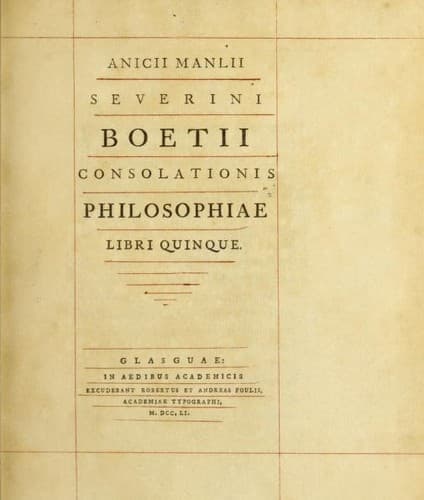
Chaucer's Translation of Boethius's "De Consolatione Philosophiae"Boethius
ReligionComparative
Chaucer's Translation of Boethius's "De Consolatione Philosophiae"
Boethius
Happiness; Philosophy and religion
¶ Eternite þan is p{er}fit possessiou{n} {and} al
togidre of lijf interminable {and} þat sheweþ more clerely
by þe co{m}parisou{n} or collac{i}ou{n} of temp{or}el þinges. 4988
[Sidenote: Temporal existence proceeds from the past to the
present, and thence to the future.]
for al þing þat lyueþ in tyme it is p{re}sent {and} p{ro}cediþ fro
preteritȝ in to fut{ur}es. þat is to sein. fro tyme passed
in to tyme comynge.
[Sidenote: And there is nothing under the law of time, which can
at once comprehend the whole space of its existence.]
ne þer nis no þing establissed i{n}
tyme þat may enbracen to-gidre al þe space of hys lijf. 4992
[Linenotes:
4977 _al þinge_--alle thinges
4979 _moche_--mochel
4980 _loken_--loke
_whiche_--which
4981 [_ek_]--from C.
4987 _clerely_--cleerly
4989 _al_--alle]
[Headnote:
THE WORLD IS NOT ETERNAL.]
[Sidenote: Having lost _yesterday_ it does not as yet enjoy
_to-morrow_; and as for _to-day_ it consists only in the present
transitory moment.]
for certys ȝit ne haþ it nat taken þe tyme of þe morwe.
{and} it haþ lost þat of ȝister-day. and certys in þe lijf
of þis day ȝe ne lyuen no more but ryȝt
as in þis moeueable [[pg 172]]
{and} t{ra}nsitorie moment.
[Sidenote: Whatever, therefore, is subjected to a temporal
condition, as Aristotle thought of the world, may be without
beginning and without end; and although its duration may extend to
an infinity of time, yet it cannot rightly be called eternal: for
it doth not comprehend at once the whole extent of its infinite
duration, having no knowledge of things future which are not yet
arrived.]
þan þilke þinge þat suffriþ 4996
temp{or}el condic{i}ou{n}. a[l]þough{e} þat [it] bygan neuer
to be. ne þough{e} it neu{er}e cese forto be. as aristotle
demde of þe worlde. and al þouȝ þat þe lif of it be
strecchid wiþ infinite of tyme.
[Sidenote: [* fol. 39.]]
ȝit al*gates nis it no 5000
swiche þing þat men myȝten trowen by ryȝt þat it is
eterne. for al þouȝ þat it comp{re}hende {and} embrace þe
space of life infinite. ȝit algates ne [em]braceþ it nat þe
space of þe lif alto-gidre. for it ne haþ nat þe fut{ur}es 5004
þat ne ben nat ȝit. ne it ne haþ no lenger þe p{re}t{er}itȝ
þat ben ydon or ypassed.
[Sidenote: For what is eternal must be always present to itself
and master of itself, and have always with it the infinite
succession of time.]
Public-domain text, read in full here on John Shaqi.
Reviews
Reviews
No reviews yet
Be the first to share your thoughts on this work.
Elsewhere in the archive
Join the Discussion
Join the discussion
Sign in to leave a comment or review.
Sign InorCreate an account