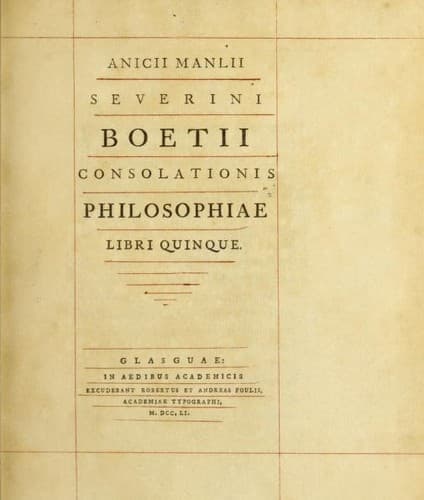
Chaucer's Translation of Boethius's "De Consolatione Philosophiae"Boethius
ReligionComparative
Chaucer's Translation of Boethius's "De Consolatione Philosophiae"
Boethius
Happiness; Philosophy and religion
p{ro}fitable destroyen þe cornes plenteuouse of frutes of reson. ¶ For
þei holden þe hertes of men i{n} usage. but þei ne delyuere not folk fro
maladye. but if ȝe muses hadde wiþdrawen fro me wiþ ȝoure flateries. any
vnkonnyng {and} vnp{ro}fitable man as men ben wont to fynde comunely
amonges þe peple. I wolde wene suffre þe lasse greuously. ¶ For-why in
syche an vnp{ro}fitable man myne ententes weren no þing endamaged. ¶ But
ȝe wiþdrawen me þis man þat haþ ben norysched in studies or scoles of
Eleaticis {and} of achademicis in grece. ¶ But goþ now raþer awey ȝe
meremaydenes wyche ben swete til it be at þe laste. {and} suffreþ þis
man to be cured {and} heled by myne muses. þat is to say by notful
sciences. ¶ And þus þis compaygnie of muses I-blamed casten wroþely þe
chere adou{n}ward to þe erþe {and} schewyng by redenesse hir schame þei
passeden sorowfuly þe þreschefolde. ¶ And I of whom þe syȝt plonged i{n}
teres was derked so þat I ne myȝt[e] not knowe what þat woman was of so
i{m}perial auctorite. ¶ I wex al a-besid {and} astoned. {and} caste my
syȝt adoune in to þe erþe. {and} bygan stille forto abide what sche
wolde don afterwarde. ¶ Þo come sche nere {and} sette hir doun vpon þe
vterrest[e] corner of my bedde. {and} sche byholdyng my chere þat was
cast to þe erþe heuy {and} greuous of wepyng. co{m}pleinede wiþ þise
wordes þ{a}t I schal sey þe p{er}t{ur}bac{i}ou{n} of my þouȝt.
HEU Q{UAM} PRECIPITI MERSA PROFUNDO.
[Sidenote: [The 2de Met{ur}.]]
++Allas how þe þouȝt of man dreint in ouer þrowyng depnesse dulleþ {and}
forletiþ hys p{ro}pre clerenesse. myntynge to gone in to foreyne
derknesses as ofte as hys anoious bisines wexiþ wiþ-oute{n} mesure.
þ{a}t is dryuen to {and} fro wiþ worldly wyndes. ¶ Þis man þat su{m}tyme
was fre to who{m} þe heuene was open {and} knowen {and} was wont to gone
in heuenelyche paþes. {and} sauȝ þe lyȝtnesse of þe rede sunne. {and}
sauȝ þe sterres of þe colde moone. {and} wyche sterre i{n} heuene vseþ
wandryng risorses yflit by dyuerse speres. ¶ Þis man ouer comere hadde
co{m}p{re}hendid al þis by noumbre. of accountyng in astronomye. ¶ And
ouer þis he was wont to seche þe causes whennes þe sounyng wy{n}des
moeuen {and} bisien þe smoþe water of þe see. {and} what spirit turneþ
þe stable heuene. {and} whi þe sterre ryseþ oute of þe reede eest. to
falle in þe westren wawes. and what attempriþ þe lusty houres of þe
fyrste somer sesou{n} þat hiȝteþ {and} apparaileþ þe erþe wiþ rosene
floures. ¶ And who makeþ þat plenteuouse autu{m}pne in fulle ȝeres
fletiþ wiþ heuy grapes. ¶ And eke þis ma{n} was wont to telle þe
dyuerses causes of nature þat weren yhid. ¶ Allas now lieþ he emptid of
lyȝt of hys þouȝt. {and} hys nekke is p{re}ssid wiþ heuy cheynes {and}
bereþ his chere enclined adoune for þe greet[e] weyȝt. and is
constreyned to loke on foule erþe.
SET MEDICINE INQUIT TEMPUS.
[Sidenote: [The ij^de p{ro}se.]]
Public-domain text, read in full here on John Shaqi.
Reviews
Reviews
No reviews yet
Be the first to share your thoughts on this work.
Elsewhere in the archive
Join the Discussion
Join the discussion
Sign in to leave a comment or review.
Sign InorCreate an account