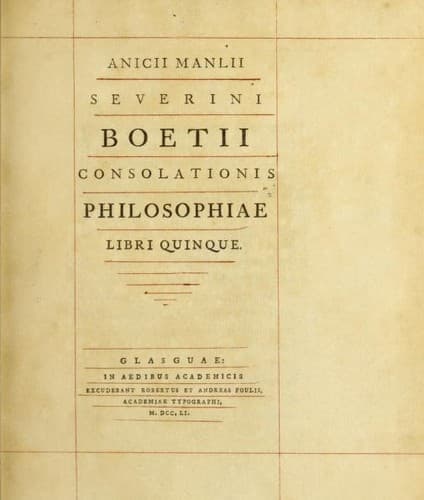
Chaucer's Translation of Boethius's "De Consolatione Philosophiae"Boethius
ReligionComparative
Chaucer's Translation of Boethius's "De Consolatione Philosophiae"
Boethius
Happiness; Philosophy and religion
¶ Allas allas wiþ how deef an eere deeþ cruel to{ur}neþ awey fro
wrecches {and} naieþ to closen wepyng eyen. ¶ While fortune vnfeiþful
fauored[e] me wiþ lyȝte goodes (.s. temp{or}els.) þe sorouful houre þat
is to seyne þe deeþ had[de] almost dreynt myne heued. ¶ But now for
fortune clowdy haþ chaunged hir disceyuable chere to me warde. myn
vnpitouse lijf draweþ a long vnagreable dwellynges in me. ¶ O ȝe my
frendes what or wherto auaunted[e] ȝe me to be weleful: for he þat haþ
fallen stood not i{n} stedfast degree.
HIC DUM MECUM TACITUS.
[Sidenote: [The firste p{ro}se.]]
++IN þe mene while þat I stille recorded[e] þise þinges wiþ my self.
{and} markede my wepli compleynte wiþ office of poyntel. I saw stondyng
aboue þe heyȝt of my heued a woman of ful greet reuerence by semblaunt
hir eyen brennyng {and} clere seing ouer þe comune myȝt of men. wiþ a
lijfly colo{ur} {and} wiþ swiche vigoure {and} strenkeþ þat it ne
myȝt[e] not be emptid. ¶ Al were it so þat sche was ful of so greet age.
þat men ne wolde not trowe i{n} no manere þat sche were of oure elde. þe
stature of hir was of a doutous iugement. for su{m}tyme sche
constreyned[e] {and} schronk hir selue{n} lyche to þe comune mesure of
men. {and} su{m}tyme it semed[e] þat sche touched[e] þe heuene wiþ þe
heyȝte of hir heued. and when sche hef hir heued heyer sche p{er}ced[e]
þe selue heuene. so þat þe syȝt of men lokyng was i{n} ydel. ¶ Hir
cloþes weren maked of ryȝt delye þredes {and} subtil crafte of
p{er}durable matere. þe wyche cloþes sche hadde wouen wiþ hir owen
hondes: as I knew wel aftir by hir selfe. declaryng {and} schewyng to me
þe beaute. þe wiche cloþes a derkenes of a forleten and dispised elde
had[de] duskid {and} dirkid as it is wo{n}t to dirken by-smoked ymages.
¶ In þe neþerest[e] hem or bordure of þese cloþes me{n} redden ywouen in
swiche a gregkysche .P. þat signifieþ þe lijf actif. And abouen þ{a}t
l{ett}re in þe heyȝest[e] bordure a grekysche T. þat signifieþ þe lijf
contemplatif. ¶ And by-twene þese two l{ett}res þere weren seien degrees
nobly wrouȝt in manere of laddres. By wyche degrees men myȝt[en] clymbe
fro þe neþemast[e] l{ett}re to þe ouermast[e]. ¶ Naþeles hondes of su{m}
men hadde korue þ{a}t cloþe by vyolence {and} by strenkeþ. ¶ And
eueryche man of hem hadde born away syche peces as he myȝte geet[e].
¶ And forsoþe þis forsaide woman ber bookes in hir ryȝt honde. {and} in
hir lefte honde sche ber a ceptre. ¶ And when sche sauȝ þese poetical
muses ap{ro}chen aboute my bedde. {and} endytyng wordes to my wepynges.
sche was a lytel ameued and glowed[e] wiþ cruel eyen. ¶ Who q{uo}d sche
haþ suffred ap{ro}chen to þis seek[e] man þise comune strumpetis of
siche a place þat men clepen þe theatr{e}. ¶ Þe wyche only ne asswagen
not his sorowes. wiþ no remedies. but þei wolde fede {and} norysche hem
wiþ swete venym. ¶ Forsoþe þise ben þo þat wiþ þornes {and} prykkynges
of talentȝ or affecciou{n}s wiche þat ben no þing frutefiyng nor
Public-domain text, read in full here on John Shaqi.
Reviews
Reviews
No reviews yet
Be the first to share your thoughts on this work.
Elsewhere in the archive
Join the Discussion
Join the discussion
Sign in to leave a comment or review.
Sign InorCreate an account