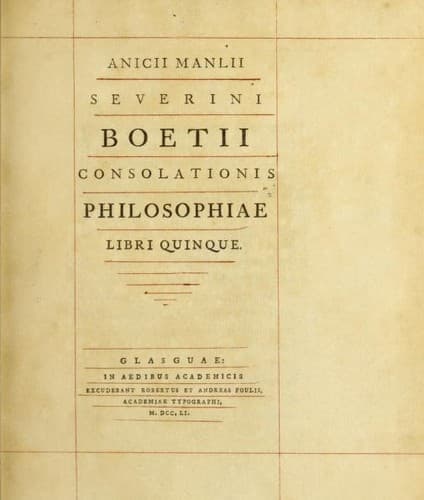
Chaucer's Translation of Boethius's "De Consolatione Philosophiae"Boethius
ReligionComparative
Chaucer's Translation of Boethius's "De Consolatione Philosophiae"
Boethius
Happiness; Philosophy and religion
++Ryȝt so {and} none oþer wyse þe cloudes of sorowe dissolued {and} don
awey. ¶ I took heuene. {and} receyuede mynde to knowe þe face of my
fyciscien. ¶ So þat I sette myne eyen on hir {and} festned[e] my lokyng.
I byholde my norice philosophie. in whos houses I hadde conuersed {and}
haunted fro my ȝouþe. {and} I seide þus. ¶ O þou maistresse of alle
uertues descendid fro þe souereyne sete. Whi art þou comen in to þis
solitarie place of myn exil. ¶ Art þou comen for þ{o}u art mad coupable
wiþ me of fals[e] blames. ¶ O q{uod} sche my norry scholde I forsake þe
now. and scholde I not parte wiþ þe by comune trauaille þe charge þat
þou hast suffred for envie of my name. ¶ Certis it nar[e] not leueful ne
sittyng to philosophie to leten wiþ-outen compaignie þe wey of hym þat
is i{n}nocent. ¶ Scholde I þan redoute my blame {and} agrisen as þouȝ
þer were byfallen a newe þing. q. d. non. ¶ For trowest þou þat
philosophi be now alþerfirst assailed i{n} p{er}ils by folk of wicked[e]
maneres. ¶ Haue I not stryuen wiþ ful greet strife in olde tyme byfore
þe age of my plato aȝeins þe foolhardines of foly {and} eke þe same
plato lyuyng. hys maistre socrates deserued[e] victorie of vnryȝtful
deeþ in my presence. ¶ Þe heritage of wyche socrates. þe h{er}itage is
to seyne þe doctrine of þe whiche soc{ra}tes in hys oppiniou{n} of
felicite þat I clepe welfulnesse ¶ Whan þat þe people of epicuriens
{and} stoyciens {and} many oþer enforceden hem to go rauische eueryche
man for his part þat is to seyne. þat to eueryche of hem wolde drawen to
þe defence of his oppiniou{n} þe wordes of socrates. ¶ Þei as in
p{ar}tie of hir preye todrowe{n} me criynge {and} debatyng þer aȝeins.
{and} tornen {and} torente{n} my cloþes þat I hadde woue{n} wiþ myn
handes. {and} wiþ þe cloutes þat þei hadden arased oute of my cloþes.
þei wenten awey wenyng þat I hadde gon wiþ he{m} euery dele. In whiche
epicuryens {and} stoyciens. for as myche as þer semed[e] so{m}me traces
{and} steppes of myne habit. þe folye of men wenyng þo epicuryens {and}
stoyciens my familers p{er}uertede (.s. p{er}sequend{o}) so{m}me þoruȝ
þe errour of þe wikked[e] or vnkunnyng[e] multitude of hem. ¶ Þis is to
seyne for þei semeden philosophres: þei weren p{ur}sued to þe deeþ and
slayn. ¶ So yif þou hast not knowen þe exilynge of anaxogore. ne þe
empoysenyng of socrates. ne þe to{ur}mentȝ of ȝeno for þei [weren]
straungers. ¶ Ȝit myȝtest þou haue knowe{n} þe senectiens {and} þe
Canyos {and} þe sorancis of wyche folk þe renou{n} is neyþer ouer oolde
ne vnsolempne. ¶ Þe whiche men no þing ellys ne brouȝt[e] hem to þe deeþ
but oonly for þei weren enfourmed of my maneres. {and} semede{n} moste
vnlyke to þe studies of wicked folk. ¶ And forþi þou auȝtest not to
wondre þouȝ þ{a}t I in þe bitter see of þis lijf be fordryuen wiþ
tempestes blowyng aboute. in þe whiche te{m}peste þis is my most
p{ur}pos þat is to seyn to displese to wikked[e] men. ¶ Of whiche
schrews al be þe oost neuer so grete it is to dispyse. for it nis
Public-domain text, read in full here on John Shaqi.
Reviews
Reviews
No reviews yet
Be the first to share your thoughts on this work.
Elsewhere in the archive
Join the Discussion
Join the discussion
Sign in to leave a comment or review.
Sign InorCreate an account