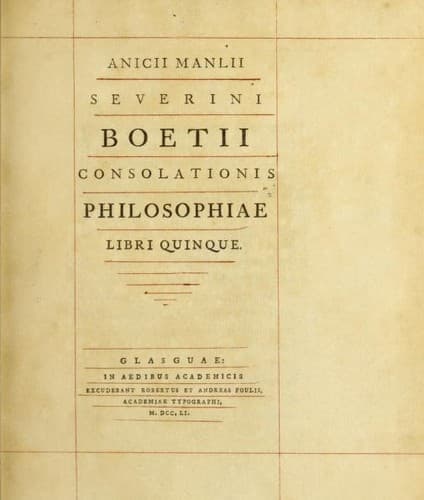
Chaucer's Translation of Boethius's "De Consolatione Philosophiae"Boethius
ReligionComparative
Chaucer's Translation of Boethius's "De Consolatione Philosophiae"
Boethius
Happiness; Philosophy and religion
{and} þer of comeþ þat good
gessyng. ¶ Fyrste of al þi{n}g forsakeþ wrecches certys it greueþ me to
þink[e] ryȝt now þe dyuerse sentences þat þe poeple seiþ of me. ¶ And
þus moche I seye þat þe laste charge of contrarious fortune is þis. þat
whan þat ony blame is laid vpon a caytif. men wenen þat he haþ deserued
þat he suffreþ. ¶ And I þat am put awey fro{m} goode men {and} despoiled
from dignitees {and} defoulid of my name by gessyng haue suffred torment
for my goode dedis. ¶ Certys me semeþ þat I se þe felonus couines of
wikked men abounden in ioie {and} in gladnes. ¶ And I se þat euery lorel
shapiþ hy{m} to fynde oute newe fraudes forto accusen goode folke. and I
se þat goode men ben ou{er}þrowen for drede of my p{er}il. ¶ and euery
luxurious to{ur}mentour dar don alle felonie vnpunissed {and} ben
excited þerto by ȝiftes. and i{n}nocentȝ ne ben not oonly despoiled of
sykernesse but of defence {and} þerfore me list to crien to god in þis
manere.
O STELLIFERI CONDITOR ORBIS.
[Sidenote: [The fifthe met{ur}.]]
++O þou maker of þe whele þat bereþ þe sterres. whiche þat art fastned
to þi p{er}durable chayere. {and} turnest þe heuene wiþ a rauyssyng
sweigh{e} {and} {con}streinest þe sterres to suffren þi lawe. ¶ So þ{a}t
þe mone somtyme schynyng wiþ hir ful hornes metyng wiþ alle þe bemes of
þe sonne. ¶ Hir broþer hideþ þe sterres þat ben lasse. {and} somtyme
whan þe mone pale wiþ hir derke hornes approcheþ þe sonne. leesith hir
lyȝtes. ¶ And þat þe euesterre esperus whiche þat in þe first[e] tyme of
þe nyȝt bryngeþ furþe hir colde arysynges comeþ eft aȝeynes hir vsed
cours. {and} is pale by þe morwe at þe rysynge of þe sonne. and is þan
cleped lucifer. ¶ Þou restreinest þe day by schorter dwellyng in þe tyme
of colde wynter þat makeþ þe leues to falle. ¶ Þou diuidest þe swifte
tides of þe nyȝt when þe hote somer is comen. ¶ Þi myȝt attempre[þ] þo
variau{n}tȝ sesons of þe ȝere. so þat ȝepherus þe deboneire wynde
bringeþ aȝein in þe first[e] somer sesou{n} þe leues þat þe wynde þat
hyȝt[e] boreas haþ reft awey in autu{m}pne. þat is to seyne in þe laste
eende of somer. and þe sedes þat þe sterre þat hyȝt arctur{us} saw ben
waxen hey[e] cornes whan þe sterre sirius eschaufeþ hym. ¶ Þere nis no
þing vnbounde from hys olde lawe ne forleteþ hym of hys p{ro}pre estat.
¶ O þou gouerno{ur} gouernyng alle þinges by certeyne ende. why refusest
þou oonly to gouerne þe werkes of men by dewe manere. ¶ Whi suffrest
þ{o}u þat slidyng fortune turneþ to grete vtter chaungynges of þinges.
so þat anoious peyne þat scholde duelly punissh{e} felouns punissitȝ
innocentȝ. ¶ And folk of wikked[e] man{er}es sitten in heiȝe chaiers.
{and} anoienge folk treden {and} þat vnryȝtfully in þe nekkes of holy
men. ¶ And vertue clere {and} schynyng naturely is hid in dirke
dirkenesses. {and} þe ryȝtful man beriþ þe blame {and} þe peyne of þe
felowne. ¶ Ne þe forsweryng ne þe fraude couered {and} kembd wiþ a fals
colo{ur} ne a-noyeþ not to schrewes.
Public-domain text, read in full here on John Shaqi.
Reviews
Reviews
No reviews yet
Be the first to share your thoughts on this work.
Elsewhere in the archive
Join the Discussion
Join the discussion
Sign in to leave a comment or review.
Sign InorCreate an account