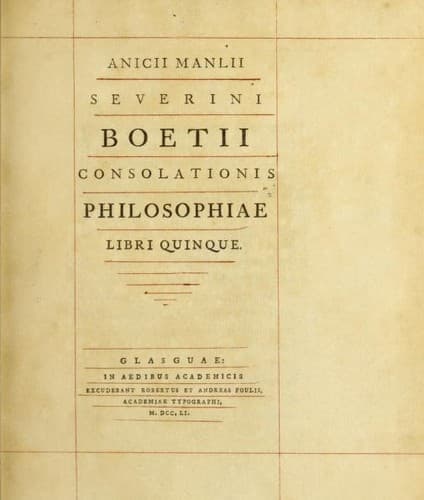
Chaucer's Translation of Boethius's "De Consolatione Philosophiae"Boethius
ReligionComparative
Chaucer's Translation of Boethius's "De Consolatione Philosophiae"
Boethius
Happiness; Philosophy and religion
I receiue peyne of fals felonie in gerdou{n} of verray
vertue. ¶ And what open co{n}fessiou{n} of felonie had[de] euer iugis so
accordaunt i{n} cruelte. þat is to seyne as myne accusyng haþ. ¶ Þat
oþer errour of mans witte or ellys co{n}diciou{n} of fortune þat is
vncerteyne to al mortal folk ne submytted[e] su{m}me of he{m}. þat is to
seyne þat it ne cheyned[e] su{m}me iuge to han pitee or compassiou{n}.
¶ For al þouȝ I had[de] ben accused þat I wolde brenne holy houses.
{and} strangle p{re}stys wiþ wicked swerde. ¶ or þat .I. had[de] grayþed
deeþ to alle goode men algatis þe sentence scholde han punysched me
p{re}sent confessed or co{n}uict. ¶ But now I am remewed fro þe Citee of
rome almost fyue-hundreþ þousand pas. I am wiþ outen defence dampned to
p{ro}sc{ri}pciou{n} {and} to þe deeþ. for þe studie {and} bountees þat I
haue done to þe senat. ¶ But o wel ben þei worþi of mercye (as who seiþ
nay.) þer myȝt[e] neuer ȝit non of hem ben conuicte. Of swiche a blame
as myn is of swiche t{r}espas myn accuso{ur}s seyen ful wel þe dignitee.
þe wiche dignite for þei wolde derken it wiþ medelyng of some felonye.
þei beren me on honde {and} lieden. þat I hadde polute {and} defouled my
conscience wiþ sacrelege. for couetise of dignite. ¶ And certys þou þi
self þat art plaunted in me chacedest oute þe sege of my corage al
couetise of mortal þinges. ne sacrilege ne had[de] no leue to han a
place in me byforne þine eyen. ¶ For þou drouppedest euery day in myn
eer{e}s {and} in my þouȝt þilk comaundement of pictogoras. þat is to
seyne men schal seruen to god. {and} not to goddes. ¶ Ne it was no
couenaunt ne no nede to taken helpe of þe foulest spirites. ¶ I þat þou
hast ordeyned or set in syche excellence þ{a}t [þou] makedest me lyke to
god. and ouer þis þe ryȝt clene secre chaumbre of myn house. þat is to
seye my wijf {and} þe co{m}paignie of myn honeste frendis. {and} my
wyues fadir as wel holy as worþi to ben reuerenced þoruȝ hys owen dedis.
defenden me of al suspecciou{n} of syche blame. ¶ But o malice. ¶ For
þei þat accusen me taken of þe philosophie feiþe of so grete blame.
¶ For þei trowen þat .I. haue had affinite to malyfice or
enchau{n}tementȝ by cause þat I am replenissed {and} fulfilled wiþ þi
techynges. {and} enformed of þi maners. ¶ And þus it sufficeþ not only
þat þi reuerence ne auayle me not. but ȝif þat þou of þi fre wille raþer
be blemissed wiþ myne offensiou{n}. ¶ But certys to þe harmes þat I haue
þere bytydeþ ȝit þis encrece of harme. þat þe gessinge {and} þe iugement
of myche folk ne loken no þing to þe[de]sertys of þinges but only to þe
aue{n}t{ur}e of fortune. ¶ And iugen þat only swiche þinges ben
p{ur}ueied of god. whiche þat temporel welefulnesse co{m}mendiþ.
_Glosa._ ¶ As þus þat yif a wyȝt haue prosperite. he is a good man {and}
worþi to haue þat p{ro}sperite. and who so haþ aduersite he is a wikked
man. {and} god haþ forsake hym. {and} he is worþi to haue þat aduersite.
¶ Þis is þe opiniou{n} of so{m}me folke.
Public-domain text, read in full here on John Shaqi.
Reviews
Reviews
No reviews yet
Be the first to share your thoughts on this work.
Elsewhere in the archive
Join the Discussion
Join the discussion
Sign in to leave a comment or review.
Sign InorCreate an account