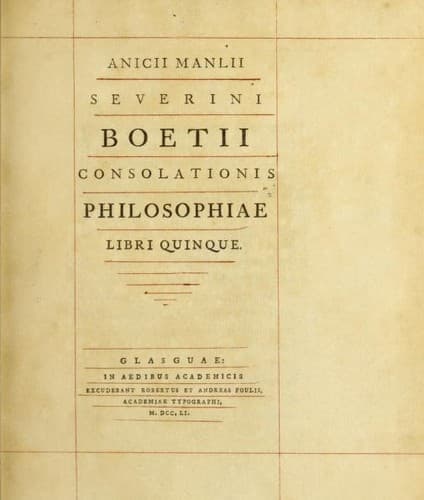
Chaucer's Translation of Boethius's "De Consolatione Philosophiae"Boethius
ReligionComparative
Chaucer's Translation of Boethius's "De Consolatione Philosophiae"
Boethius
Happiness; Philosophy and religion
++CErtis I wolde plete wiþ þee a fewe þinges vsynge þe wordes of fortune
tak heede now þi self. yif þ{a}t she axeþ ryȝt. ¶ O þou man wher fore
makest þou me gilty by þine euerydayes pleynynges. what wronges haue I
don þe. what goodes haue I byreft þe þat weren þine. stryf or plete wiþ
me by fore what iuge þat þou wilt of þe possessiou{n} of rycchesse or of
dignites ¶ And yif þou maist shewe me þat euer any mortal man haþ
receyued any of þese þinges to ben his in p{ro}pre. þan wol I graunt[e]
frely þat [alle] þilke þinges were{n} þine whiche þat þou axest. ¶ Whan
þat nature brouȝt[e] þe forþe out of þi moder wombe. I receyued[e] þe
naked {and} nedy of al þing. {and} I norysshed[e] þe wiþ my rychesse.
{and} was redy {and} ententif þo{ru}ȝ my fauo{ur} to sustene þe. ¶ And
þat makeþ þe now i{n}pacient aȝeins me. {and} I envirounde þe wiþ al þe
habundaunce {and} shinyng of al goodes þat ben in my ryȝt. ¶ Now it
lykeþ me to wiþ drawe myne hande. þou hast had grace as he þat haþ vsed
of foreyne goodes. þou hast no ryȝt to pleyne þe. as þouȝ þou haddest
vtterly lorn alle þi þinges. whi pleynest þou þan. I haue don þe no
wrong. Ricches hono{ur}es {and} swyche oþer þinges ben of my ryȝt. ¶ My
seruauntes knowen me for hir lady. þei comen wiþ me {and} dep{ar}ten
whan I wende. I dar wel affermen hardyly. þat yif þo þinges of whiche
þou pleynest þat þou hast forlorn hadde ben þine. þou ne haddest not
lorn he{m}. ¶ shal I þan only be defended to vse my ryȝt. ¶ Certis it is
leueful to þe heuene to make clere dayes. {and} after þat to keuere þe
same dayes wiþ derke nyȝtes. ¶ Þe erþe haþ eke leue to apparaile þe
visage of þe erþe now w{i}t{h} floures {and} now wiþ fruyt. {and} to
confounde he{m} so{m}tyme wiþ raynes {and} wiþ coldes. ¶ Þe see haþ eke
hys ryȝt to be somtyme calme {and} blaundyshing wiþ smoþe water. {and}
somtyme to be horrible wiþ wawes {and} wiþ tempestes. ¶ But þe couetyse
of men þat may not be staunched shal it bynde me to be stedfast. syn þat
stedfastnesse is vnkouþ to my maneres. ¶ Swyche is my strengþe. {and}
þis pley. I pley[e] co{n}tinuely. I tourne þe whirly{n}g whele wiþ þe
tournyng cercle ¶ I am glade to chaunge þe lowest to þe heyeste. {and}
þe heyest to þe loweste. worþe vp yif þou wilt. so it be by þis lawe.
þat þou ne holde not þat I do þe wronge þouȝ þou descende dou{n} whanne
resou{n} of my pleye axeþ it. Wost þou not how Cresus kyng of lyndens of
whiche kyng Cir{us} was ful sore agast a litel byforne þat þis rewlyche
Cresus was cauȝt of Cirus {and} lad to þe fijr to be brent. but þat a
reyne desce{n}ded[e] dou{n} from heuene þat rescowed[e] hym ¶ And is it
out of þi mynde how þat Paulus consul of Rome whan he hadde take þe kyng
of p{er}ciens weep pitou[s]ly for þe captiuitee of þe self[e] kyng. What
oþer þinges bywaylen þe criinges of Tragedies. but only þe dedes of
fortune. þat wiþ an vnwar stroke ouert{ur}neþ þe realmes of grete nobley
¶ _Glose._ Tragedie is to seyne a dite of a p{ro}sp{er}ite for a tyme
Public-domain text, read in full here on John Shaqi.
Reviews
Reviews
No reviews yet
Be the first to share your thoughts on this work.
Elsewhere in the archive
Join the Discussion
Join the discussion
Sign in to leave a comment or review.
Sign InorCreate an account