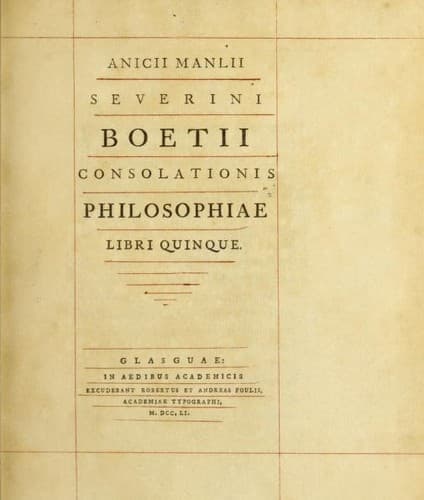
Chaucer's Translation of Boethius's "De Consolatione Philosophiae"Boethius
ReligionComparative
Chaucer's Translation of Boethius's "De Consolatione Philosophiae"
Boethius
Happiness; Philosophy and religion
¶ But naþeles some bookes han þe text þus. For soþe she haþ forsaken þe
ne þer nis no man syker þat she ne haþ not forsaken. ¶ Holdest þou þan
þilke welefulnesse p{re}ciouse to þe þat shal passen. {and} is p{re}sent
fortune derworþi to þe. whiche þat nis not feiþful forto dwelle. {and}
whan she goþ aweye þat she bryngeþ a wyȝt in sorwe ¶ For syn she may nat
be wiþholde{n} at a mans wille. she makeþ hym a wrecche whe{n} she
dep{ar}teþ fro hym. ¶ What oþer þing is flitti{n}g fortune but a manere
shewyng of wrycchednesse þat is to comen. ne it ne suffriþ nat oo[n]ly
to loken of þing þat is p{re}sent byforne þe eyen of man. but wisdom
lokeþ {and} mesureþ þe ende of þinges. {and} þe same chau{n}gyng from
one to an oþer. þat is to seyne fro aduersite to p{ro}sperite makeþ þat
þe manaces of fortune ne ben not forto dreden. ne þe flatrynges of hir
to ben desired. ¶ Þus atte þe last it byhoueþ þe to suffren wiþ euene
wille in pacience al þat is don inwiþ þe floor of fortune. þat is to
seyne in þis worlde. ¶ Syþen þou hast oones put þi nekke vnder þe ȝokke
of hir. for if þou wilt write a lawe of wendyng {and} of dwellyng to
fortune whiche þat þou hast chosen frely to be þi lady ¶ Art þou nat
wrongful in þat {and} makest fortune wroþe {and} asp{er}e by þin
inpacience. {and} ȝit þou mayst not chaungen hir. ¶ Yif þou co{m}mittest
[{and}] bitakest þi sayles to þe wynde. þou shalt be shouen not þider
þat þou woldest(:) but whider þat þe wy{n}de shoueþ þe ¶ Yif þou castest
þi seedes in þe feldes þou sholdest haue in mynde þat þe ȝeres ben oþer
while plenteuous {and} oþ{er} while bareyne. ¶ Þou hast bytaken þiself
to þe gouernaunce of fortune. {and} forþi it byhoueþ þe to ben obeisaunt
to þe manere of þi lady. and enforcest þou þe to aresten or wiþstonden
þe swyftnesse {and} þe sweyes of hir to{ur}nyng whele. ¶ O þou fool of
alle mortel fooles if fortune bygan to dwelle stable. she cesed[e] þan
to ben fortune.
HEC CUM SUPERBA.
[Sidenote: [The fyrst met{ur}.]
++Whan fortune wiþ a proude ryȝt hande haþ turnid hir chau{n}gyng
stoundes she fareþ lyke þe maners of þe boillyng eurippe. _Glose._
Eurippe is an arme of þe see þ{a}t ebbith {and} flowiþ. {and} somtyme þe
streme is on one syde {and} somtyme on þat oþer. _Texte_ ¶ She cruel
fortune kasteþ adoune kynges þat somtyme weren ydred. {and} she
deceiuable enhau{n}seth vp þe humble chere of hym þat is discomfited.
{and} she neyþer hereþ ne reccheþ of wrecched[e] wepynges. {and} she is
so harde þat she lauȝeþ {and} scorneþ þe wepyng of hem þe whiche she haþ
maked wepe wiþ hir free wille. ¶ Þus she pleyeþ {and} þ{us} she p{re}ueþ
hir strengþe {and} sheweþ a grete wondre to alle hir seruau{n}tȝ. ¶ Yif
þat a wyȝt is seyn weleful {and} ou{er}þrowe in an houre.
VELLEM AUTE{M} PAUCA.
[Sidenote: [The secunde p{ro}se.]]
Public-domain text, read in full here on John Shaqi.
Reviews
Reviews
No reviews yet
Be the first to share your thoughts on this work.
Elsewhere in the archive
Join the Discussion
Join the discussion
Sign in to leave a comment or review.
Sign InorCreate an account