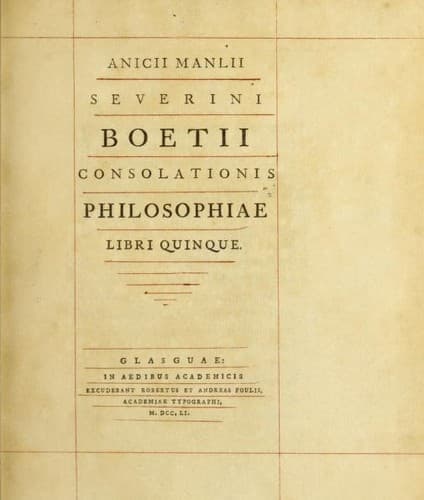
Chaucer's Translation of Boethius's "De Consolatione Philosophiae"Boethius
ReligionComparative
Chaucer's Translation of Boethius's "De Consolatione Philosophiae"
Boethius
Happiness; Philosophy and religion
¶ O þou gouerno{ur} gouernyng alle þinges by certeyne
ende. why refusest þou oonly to gouerne þe werkes of
men by dewe manere.
[Sidenote: Why should fickle fortune be allowed to work such
mighty changes in the world?]
¶ Whi suffrest þ{o}u þat slidyng 528
fortune turneþ to grete vtter chaungynges of þinges.
so þat anoious peyne þat scholde duelly punissh{e} felouns
punissitȝ innocentȝ.
[Sidenote: The wicked are prosperous, while the righteous are in
adversity.]
¶ And folk of wikked[e]
man{er}es sitten in heiȝe chaiers. {and} anoienge folk 532
treden {and} þat vnryȝtfully in þe nekkes of holy men. [[pg 23]]
¶ And vertue clere {and} schynyng naturely is hid in
dirke dirkenesses. {and} þe ryȝtful man beriþ þe blame
{and} þe peyne of þe felowne. ¶ Ne þe forsweryng ne 536
þe fraude couered {and} kembd wiþ a fals colo{ur} ne
a-noyeþ not to schrewes. ¶ Þe whiche schrewes whan
hem lyst to vsen her strengþe þei reioisen hem to
putte{n} vndir hem þe souerayne kynges. whiche þ{a}t 540
poeple wiþ[outen] noumbre dreden.
[Sidenote: O thou that bindest the disagreeing elements, look upon
this wretched earth, and, as thou dost govern the spacious
heavens, so let the earth be firmly bound.]
¶ O þou what so
euer þou be þat knyttes[t] alle bondes of þinges loke
on þise wrecched[e] erþes. we men þat ben nat a
foule party but a faire party of so grete a werke we 544
ben turmentid in þe see of fortune. ¶ Þou gouerno{ur}
wiþdraw {and} restreyne þe rauyssinge flodes {and} fastne
{and} forme þise erþes stable wiþ þilke [bonde] wiþ
whiche þou gouernest þe heuene þat is so large. 548
[Linenotes:
527 _refusest þou_--refowsestow
529 _to----þinges_--so grete entrechaunginges of thynges
531 _punissitȝ_--punysshe
_wikked[e]_--wykkede
532 _heiȝe_--heer{e}
533 _in_--oon
534 {and}--omitted
536 _Ne þe forsweryng_--Ne forswerynge
537 _kembd_--MS. kembde, C. kembd
541 _wiþ[outen]_--withhowtyn
542 _knyttes[t]_--knyttest
543 _wrecched[e]_--wrecchede
544 _a_ (2)--omitted
545 _þe_--this
546 _wiþdraw_--MS. wiþdrawe, C. withdrawh
_þe_--thei
547 _forme_--ferme
[_bonde_]--from C.
_wiþ_--by]
[Headnote:
PHILOSOPHY CONSOLES BOETHIUS,]
HIC UBI CONTINUATO DOLORE.
[Sidenote: [The fyfthe p{ro}se.]]
[Sidenote: Philosophy consoles Boethius.]
++Whan I hadde wiþ a continuel sorwe sobbed or
broken out þise þinges sche wiþ hir chere peisible
{and} no þi{n}g amoeued. wiþ my compleyntes seide þ{us}.
whan I say þe q{uod} sche sorweful {and} wepyng I wist[e] 552
on-one þat þou were a wrecche {and} exiled. but I
wist[e] neuer how fer þine exile was: ȝif þi tale ne
hadde schewed it to me. but certys al be þou fer fro þi
contre.
Public-domain text, read in full here on John Shaqi.
Reviews
Reviews
No reviews yet
Be the first to share your thoughts on this work.
Join the Discussion
Join the discussion
Sign in to leave a comment or review.
Sign InorCreate an account