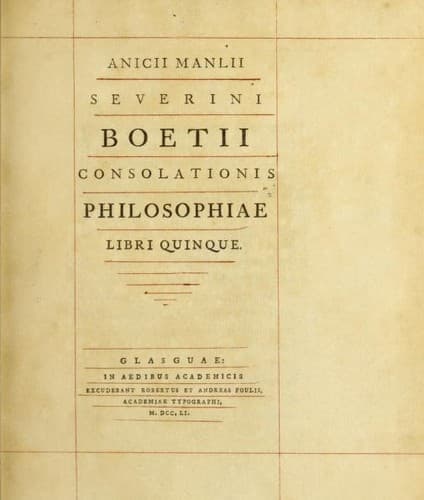
Chaucer's Translation of Boethius's "De Consolatione Philosophiae"Boethius
ReligionComparative
Chaucer's Translation of Boethius's "De Consolatione Philosophiae"
Boethius
Happiness; Philosophy and religion
[Sidenote: [* fol. 7 _b_.]]
þou nart *nat put out of it. but þou hast 556
fayled of þi weye {and} gon amys.
[Sidenote: She speaks to him of his country.]
¶ and yif þou hast
leuer forto wene þan þou be put out of þi contre. þan
hast þou put oute þi self raþer þen ony oþer wyȝt haþ.
[Linenotes:
550 _broken_--borken
552 _wist[e]_--wyste
553 _on-one_--anon
554 _wist[e]_--wyste
_fer_--ferr{e}
555 _ne hadde_--nadde
557 _gon_--MS. gone, C. gon
558 _leuer_--leuer{e}
558, 559 _put_--MS. putte, C. put
559 _haþ_--MS. haþe]
[Headnote:
AND PROPOSES TO ADMINISTER REMEDIES.]
¶ For no wyȝt but þi self ne myȝt[e] neuer haue don 560
þat to þe. [[pg 24]]
[Sidenote: She reminds him that he is a citizen of a country not
governed by a giddy multitude, but εἷς κοίρανός ἐστιν, εἷς
βασιλεύς.]
¶ For ȝif þou remembre of what contre þou
art born. it nis not gou{er}ned by emp{er}oures. ne by
gouernement of multitude. as weren þe contres of hem
of athenes. ¶ But o lorde {and} o kyng {and} þat is god 564
þat is lorde of þi contree. whiche þat reioiseþ hym of
þe dwellyng of hys Citeȝenis. {and} not forto putte hem
in exile. Of þe whiche lorde it is a souerayne fredom
to be gouerned by þe bridel of hym and obeie to his 568
iustice.
[Sidenote: The Commonwealth of Boethius.]
¶ Hast þou forȝeten þilke ryȝt olde lawe of þi
Citee. in þe whiche Citee it is ordeyned {and} establissed
þat what wyȝt þat haþ leuer founden þer i{n}ne hys sete
or hys house. þen ellys where: he may not be exiled 572
by no ryȝt fro þat place. ¶ For who so þat is co{n}tened
in-wiþ þe paleis [{and} the clos] of þilke Citee. þer nis
no drede þat he may deserue to ben exiled. ¶ But
who þat letteþ þe wille forto enhabit[e] þere. he forleteþ 576
also to deserue to ben Citeȝein of þilke Citee.
[Sidenote: Philosophy says she is moved more by the looks of
Boethius than by his gloomy prison.]
¶ So þat I seye þat þe face of þis place ne amoeueþ me
nat so myche as þine owen face. Ne .I. ne axe not
raþer þe walles of þi librarie apparailled {and} wrouȝt 580
wiþ yvory {and} wiþ glas þan after þe sete of þi þouȝt.
[Sidenote: Books are to be valued on account of the _thoughts_
they contain.]
In whiche I putte nat somtyme bookes. but .I. putte
þat þat makeþ bookes worþi of p{ri}s or p{re}cious þat is
to sein þe sentence of my books. ¶ {And} certeinly of 584
þi dec{er}tes by-stowed in co{m}mune good. þou hast seid
soþe but after þe multitude of þi goode dedys. þou hast
seid fewe. {and} of þe vnhonestee or falsnesse of þinges
þat ben opposed aȝeins þe. þou hast remembred þinges 588
þat be{n} knowe to alle folk.
Public-domain text, read in full here on John Shaqi.
Reviews
Reviews
No reviews yet
Be the first to share your thoughts on this work.
Elsewhere in the archive
Join the Discussion
Join the discussion
Sign in to leave a comment or review.
Sign InorCreate an account