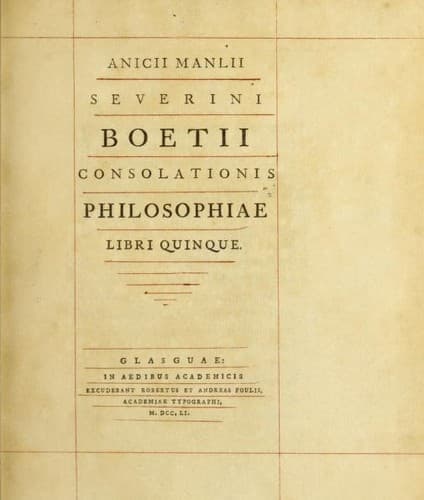
Chaucer's Translation of Boethius's "De Consolatione Philosophiae"Boethius
ReligionComparative
Chaucer's Translation of Boethius's "De Consolatione Philosophiae"
Boethius
Happiness; Philosophy and religion
[Linenotes:
680 _hast left_--MS. haste lefte, C. hast left
681 _knowe_--knowen
_pleynelyche knowen_--pleynly fwonde [= founde]
684 _sorwest þou_--sorwistow
686 _for[þi] demest [þou]_--For thy demesthow
687 _wikked_--MS. wilked, C. wykkyd
688 _worlde_--world
689 _wenest þou_--wenestow
690 _outen_--owte
693 _haþ_--MS. haþe
_al_--alle
694 _þi_--thin
696 _vnderput_--vndyrputte
697 _to_ (2)--omitted
698 _fore_--for
_noþing_--nothinge
699 _spark þine heet_--sparke thin hete
700 _muche_--meche
702 _aweye_--away
703 [_of----opyniouns_]--from C.
705 _insyȝt_--insyhte
_say_--assaye
706 _lyȝt_--lyhte
708 _don_--MS. don{e}
_mow[e]_--mowe]
[[pg 29]]
[Headnote:
HE IS NOT TO TAKE HIS LOSSES TO HEART.]
NUBIB{US} ATRIS CONDITA.
[Sidenote: [The seuende Metyr.]]
[Sidenote: Black clouds obscure the light of the stars.]
++ÞE sterres cou{er}ed wiþ blak[e] cloudes ne mowen
geten a dou{n} no lyȝt.
[Sidenote: If the south wind renders the sea tempestuous, the
waves, fouled with mud, will lose their glassy clearness.]
Ȝif þe trouble wy{n}de þat
hyȝt auster stormynge {and} walwy{n}g þe see medleþ þe 712
heete þat is to seyne þe boylyng vp from þe botme
¶ Þe wawes þ{a}t somtyme weren clere as glas {and}
lyke to þe fair[e] bryȝt[e] dayes wiþstant anon þe
syȝtes of men. by þe filþe {and} ordure þat is resolued. 716
{and} þe fletyng streme þat royleþ dou{n} dyuersely fro
heyȝe mou{n}taignes is arestid {and} resisted ofte tyme
by þe encountrynge of a stoon þ{a}t is dep{ar}tid {and}
fallen from some roche. 720
[Sidenote: If thou wouldst see truth by the clearest light, pursue
the path of right.]
¶ And forþi yif þou wilt
loken {and} demen soþe wiþ clere lyȝt. {and} holde þe
weye wiþ a ryȝt paþe.
[Sidenote: Away with joy, fear, hope, and sorrow.]
¶ Weyue þou ioie. drif fro þe
drede. fleme þou hope. ne lat no sorwe ap{ro}che.
[Sidenote: Let none of these passions cloud thy mind.]
þat is
to sein lat noon of þise four passiou{n}s ouer come þe. 724
or blynde þe.
[Sidenote: Where these things control, the soul is bound by strong
fetters.]
for cloudy {and} dirke is þilk þouȝt {and}
bounde w{i}t{h} bridles. where as þise þinges regnen.
EXPLICIT LIBER PRIMUS.
Public-domain text, read in full here on John Shaqi.
Reviews
Reviews
No reviews yet
Be the first to share your thoughts on this work.
Elsewhere in the archive
Join the Discussion
Join the discussion
Sign in to leave a comment or review.
Sign InorCreate an account