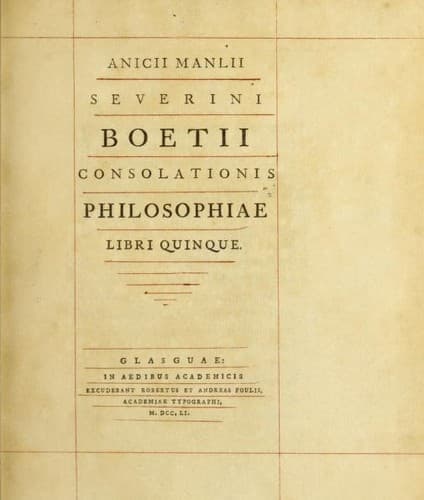
Chaucer's Translation of Boethius's "De Consolatione Philosophiae"Boethius
ReligionComparative
Chaucer's Translation of Boethius's "De Consolatione Philosophiae"
Boethius
Happiness; Philosophy and religion
[Linenotes:
710 _blak[e]_--blake
712 _stormynge_--turnyng
713 _from_--fro
714 _somtyme_--whilom
715 _lyke_--lyk
_fair[e]----wiþstant_ (MS. wiþstante)--fayr{e} cleer{e} dayes
{and} brihte withstand
716 _syȝtes_--syhtes
717 _streme_--strem
718 _heyȝe_--hy
720 _from some_--fram som
_wilt_--wolt
721 _soþe_--soth
_clere_--cleer
_holde_--holden
722 _weye_--wey
_paþe_--paath
724 _come_--comen
725 _blynde_--blende
_þilk_--thilke]
[Headnote:
PHILOSOPHY EXHIBITS TO BOETHIUS THE WILES OF FORTUNE.]
INCIPIT LIBER SECUNDUS.
POSTEA [PAU]LISPER CONTICUIT.
[Sidenote: [The fyrst p{ro}se.]]
[Sidenote: Philosophy exhorts Boethius not to torment himself on
account of his losses.]
++After þis she stynte a litel. and after þat she hadde
gadred by atempre stillenesse myn attenciou{n} she 728
seide þus.
[Sidenote: Thou art, she says, affected by the loss of thy former
fortune.]
¶ As who so myȝt[e] seye þus. After þise
þinges she stynt[e] a lytel. {and} whanne she ap{er}ceiued[e]
by atempre stillenesse þat I was ententif to
herkene hire. she bygan to speke in þis wyse. ¶ Yif 732
I q{uod} she haue vnderstonde{n} {and} knowe vtterly þe [[pg 30]]
causes {and} þe habit of þi maladie. þou languissed {and}
art deffeted for talent {and} desijr of þi raþer fortune.
[Sidenote: It hath perverted thy faculties.]
¶ She þat ilke fortune only þat is chaunged as þou 736
feinest to þe ward. haþ p{er}uerted þe clerenesse {and} þe
astat of þi corage.
[Sidenote: I am well acquainted with all the wiles of that Prodigy
(_i. e._ Fortune).]
¶ I vnderstonde þe felefolde
colo{ur} {and} deceites of þilke merueillous monstre fortune.
and how she vseþ ful flatryng familarite wiþ hem 740
þat she enforceþ to bygyle. so longe til þat she co{n}founde
wiþ vnsuffreable sorwe hem þat she haþ left
in despeir vnpurueyed.
[Sidenote: Though she has left thee, thou hast not lost anything
of beauty or of worth.]
¶ and if þou remembrest wel
þe kynde þe maners {and} þe desert of þilke fortune. þow 744
shalt wel knowe as in hir þou neuer ne haddest ne
hast ylost any fair þing. But as I trowe I shal not
gretly trauaile to don þe remembren of þise þinges.
[Sidenote: Thou wert once proof against her allurements.]
¶ For þou were wont to hurtlen [{and} despysen] hir 748
wiþ manly wordes whan she was blaundissinge {and}
presente {and} p{ur}sewedest hir wiþ sentences þat were
drawe{n} oute of myne entre. þat is to seyne out of
myn i{n}formac{i}ou{n}
[Sidenote: But sudden change works a great alteration in the minds
of men, hence it is that thou art departed from thy usual peace of
mind.]
Public-domain text, read in full here on John Shaqi.
Reviews
Reviews
No reviews yet
Be the first to share your thoughts on this work.
Elsewhere in the archive
Join the Discussion
Join the discussion
Sign in to leave a comment or review.
Sign InorCreate an account