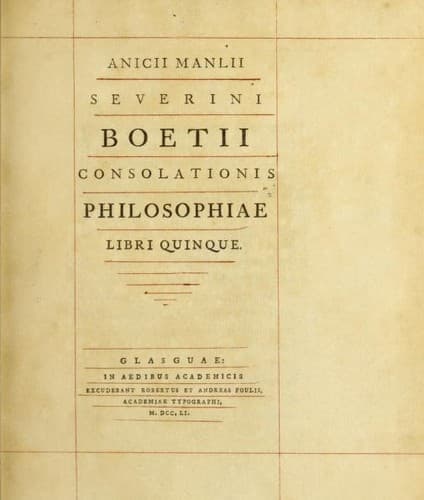
Chaucer's Translation of Boethius's "De Consolatione Philosophiae"Boethius
ReligionComparative
Chaucer's Translation of Boethius's "De Consolatione Philosophiae"
Boethius
Happiness; Philosophy and religion
[Sidenote: A third is blest with both advantages, but is
unmarried.]
and som ma{n} habundeþ boþe i{n}
rychesse {and} noblesse. but ȝit he bywaileþ hys chast[e]
lijf. for he haþ no wijf. [[pg 42]]
[Sidenote: This man is happy in a wife, but is childless, while
that other man has the joy of children, but is mortified by their
evil ways.]
¶ and som man is wel {and}
selily maried but he haþ no children. {and} norissheþ his 1076
ricchesse to þe heires of straunge folk. ¶ And som
man is gladded wiþ children. but he wepiþ ful sory for
þe trespas of his son or of his douȝtir.
[Sidenote: Thus we see that no man can agree easily with the state
of his fortune.]
¶ and for þis
þer accordeþ no wyȝt lyȝtly to þe condic{i}ou{n} of his fortune. 1080
for alwey to euery man þere is i{n} mest somwhat
þat vnassaieþ he ne wot not or ellys he drediþ þat he
haþ assaied.
[Sidenote: The senses of the happy are refined and delicate, and
they are impatient if anything is untoward.]
¶ {And} adde þis also þat euery weleful
man haþ a wel delicat felyng. ¶ So þat but yif alle 1084
þinges fallen at hys owen wille for he inpacient or is
nat vsed to han none aduersitee. an-oone he is þrowe
adoũne for euery lytel þing.
[Sidenote: The happiness of the most fortunate depends on
trifles.]
¶ And ful lytel þinges
ben þo þat wiþdrawen þe so{m}me or þe p{er}fecc{i}ou{n} of 1088
blisfulnesse fro hem þat ben most fortunat.
[Sidenote: How many would think themselves in heaven if they had
only a part of the remnant of thy fortune!]
¶ How
many men trowest þou wolde demen hem self to ben
almost in heuene yif þei myȝten atteyne to þe leest[e]
p{ar}tie of þe remenaunt of þi fortune. ¶ Þis same place 1092
þat þou clepist exil is contre to hem þat enhabiten
here.
[Sidenote: Thy miseries proceed from the thought that thou art
miserable.]
{and} forþi. Noþing wrecched. but whan þou
wenest it
[Sidenote: Every lot may be happy to the man who bears his
condition with equanimity and courage.]
¶ As who seiþ. þouȝ þi self ne no wyȝt
ellys nys no wrecche but whan he weneþ hym self a 1096
wrecche by reputac{i}ou{n} of his corage.
Public-domain text, read in full here on John Shaqi.
Reviews
Reviews
No reviews yet
Be the first to share your thoughts on this work.
Elsewhere in the archive
Join the Discussion
Join the discussion
Sign in to leave a comment or review.
Sign InorCreate an account