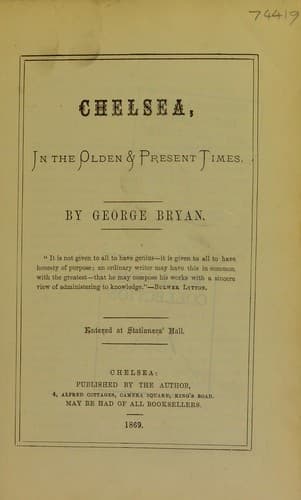
Chelsea, in the Olden & Present TimesBryan, George
History
Chelsea, in the Olden & Present Times
Bryan, George
Chelsea (London, England) -- History
Payd Mr. Tuley for cureing Charles Matthews’s toes of a
mortification, £2 5s.
Gave Stacey, for shaving a child’s head, 6d.
1707. Ordered, in Vestry, that the weekly pensioners shall wear
badges, according to the Act of Parliament, or else be
excluded from the said weekly pension.
1782. Resolved to employ a number of labourers to cut off all the
little twigs, in order to destroy certain insects which
appear everywhere in our trees and hedges; and from which
the most dreadful consequences are apprehended if they are
suffered to remain.
1795. Resolved, that a bounty of twenty guineas be offered and
paid to eight men, agreeably to Act of Parliament, for the
service of his Majesty’s navy; and, if not sufficient, the
churchwardens to have power to augment the same.
1796. Resolved to make a rate of 4d. in the pound to defray the
necessary expenses of raising eleven men for the service of
his Majesty’s navy.
As the population increased the records of the parish naturally became
more voluminous, and for many years past the proceedings of the
vestrymen, and also of the Board of Guardians, are kept in the most
admirable manner. This, it is true, is the effect of the improved state
of society, the passing of the Metropolis Local Management Act, 1855, and
the introduction of better Laws for the relief and maintenance of the
poor.
THE PAROCHIAL SCHOOLS.
These schools are situated at the east side of the Cemetery. The pointed
style was adopted on account of the contiguity of the building to the
Parish Church. It consists of a centre, with low wings. The wings are
occupied by the schools, and the centre as residences intended for the
master and mistress; a large pointed arch connects the two divisions.
The first stone was laid on the 18th of June, 1824, by the Hon. and Rev.
Dr. Wellesley, rector, with the customary formalities, at which there
were present the late Rev. Henry Blunt, and several other clergymen,
besides a vast number of the parishioners, including many ladies. In
1826 the entire building was finished, and the children were admitted.
CHELSEA WORKHOUSE.
Before the year 1723 there were no workhouses in England. It was the
custom to relieve the able-bodied at their own dwelling places, and the
aged and infirm were, in many cases, supported by the alms given at the
church. In 1727, it was “agreed that the churchwardens should be
empowered to take, with all convenient speed, a proper house upon lease,
in the name of the parish, for the use of the poor.” In 1733 it was
resolved, at a vestry, “That a committee be appointed to find out the
most proper method to procure a workhouse for the poor, and an additional
burial ground.” The result was that Sir Hans Sloane gave the present
ground for both purposes, and the first erection of the workhouse took
place about 1737.
Public-domain text, read in full here on John Shaqi.
Reviews
Reviews
No reviews yet
Be the first to share your thoughts on this work.
Elsewhere in the archive
Join the Discussion
Join the discussion
Sign in to leave a comment or review.
Sign InorCreate an account