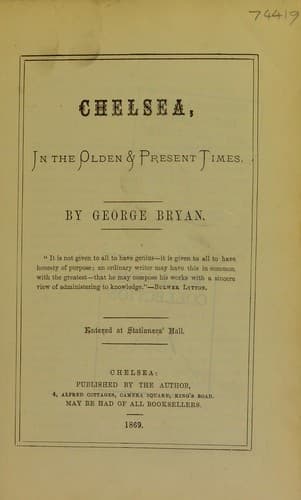
Chelsea, in the Olden & Present TimesBryan, George
History
Chelsea, in the Olden & Present Times
Bryan, George
Chelsea (London, England) -- History
* * * * *
The building, at the early part of this century, contained but few
dwelling rooms, besides those occupied by the master and mistress. It
had two wings, however, the one to the south-west was built in 1792, and
the south-east wing in 1797. The whole did not occupy much space. There
was a garden, tastefully laid out, with a neat box-edging around each
compartment. {150} An aged inmate was the gardener, and he took great
delight in keeping it in good order. How altered is now the appearance
of the workhouse! The pretty garden, where once I plucked a flower, has
long since disappeared, and on its site are erected extensive buildings,
to afford necessary accommodation for the vast increase of inmates.
Since the period to which I first alluded many additions have been made
to the original workhouse, and consequently it was altogether devoid of
uniformity; but as it has been within the last few years almost rebuilt,
under the direction of G. Handford, Esq., architect and surveyor, of the
King’s Road, the defect mentioned is no longer apparent. Indeed, unless
it had been an entire new erection, no further improvement, as regards
the exterior, could have been made. The interior is well arranged, both
for comfort and convenience. There are at the present time upwards of
560 inmates, and the Guardians afford every reasonable indulgence to the
aged and deserving amongst them. Thomas Symons, Esq., the Chairman of
the Board, is highly esteemed by the parishioners, and they have recently
presented to him a very handsome testimonial of respect.
THE KING’S ROAD CEMETERY.
This cemetery adjoins the workhouse, and the ground was the gift of Sir
Hans Sloane. It was consecrated in 1736, by Edmund Gibson, Bishop of
London. In 1790 it was enlarged by a grant from Lord Cadogan.
* * * * *
The obelisk, near the centre, was erected to the memory of Andrew Millar,
an eminent bookseller in London, who died in 1768, aged 61 years; he had
little pretensions to learning, but possessed a very nice discrimination
in selecting his literary counsellors.
* * * * *
On a flat stone, on the north side, is an inscription in memory of John
Martyn, F.R.S., Professor of Botany at Cambridge, and Eulalia, his wife,
youngest daughter of the Rev. Dr. King, rector. She died in 1748–9, and
Mr. Martyn in 1768.
* * * * *
John Baptist Cipriani, the celebrated artist, and one of the earliest
members of the Royal Academy, was interred in this burial ground. On the
north side is a tomb to his memory. Cipriani excelled in delineating the
human figure, and was much employed by the printsellers in making
drawings, which are well known by Bartolozzi’s beautiful engravings from
them; he died in 1785, aged 58.
* * * * *
Public-domain text, read in full here on John Shaqi.
Reviews
Reviews
No reviews yet
Be the first to share your thoughts on this work.
Elsewhere in the archive
Join the Discussion
Join the discussion
Sign in to leave a comment or review.
Sign InorCreate an account