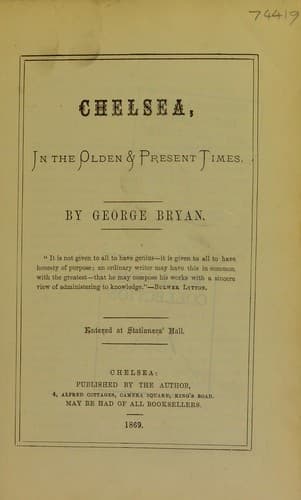
Chelsea, in the Olden & Present TimesBryan, George
History
Chelsea, in the Olden & Present Times
Bryan, George
Chelsea (London, England) -- History
The parish of Chelsea, by Lady Dacre’s will, have some presentations to
her Almshouses in Westminster, on condition of keeping the monument in
repair. It has been lately painted and beautified. Lord Dacre died in
1594, and Lady Dacre in 1595. This monument was originally placed in Sir
T. More’s chapel, it is so described in Lady Dacre’s will. When the
church was almost rebuilt in 1667, it was placed in its present
situation.
* * * * *
On a marble tablet, against the same wall, is an inscription to the
memory of Catherine, wife of the Rev. T. Mahon, Rector of Newport, Co. of
Mayo, Ireland, who died in 1822, aged 20.
* * * * *
SIR ARTHUR GORGES.—Bowack, in his “Antiquities of Middlesex,” mentions a
monument raised about 4 ft. from the ground, with the effigies of Sir
Arthur Gorges, his lady, three sons, and five daughters, in brass plates
fixed thereon, no trace of it can now be discovered. There is, however,
on a black slab, fixed against the north wall of Sir Thomas More’s
chapel, an inscription to the memory of Arthur Gorges, Esq. (eldest son
of Sir Arthur Gorges), who died in 1668. He married Mary, daughter of
Lord Bayning. This was her third marriage. She is here buried with her
husband.
* * * * *
SIR THOMAS MORE’S CHAPEL, which was built by him, belonged to the
proprietor of his house until it was sold by Arthur Gorges, Esq., to
Lionel, Earl of Middlesex, when he reserved the chapel to himself, as he
continued to reside at Chelsea in another house. In 1664, when he sold
the last-mentioned house, he only renewed a right of burial for his
family. The chapel passed therefore with the house, through various
owners, to Sir William Milman, and ultimately it became the freehold
property, for many years, of the late Mr. Mann, of Paradise Row, now
called Queen’s Road West. It is still private property. A large Gothic
arch opens into the chancel, and is supported by pillars, the capitals of
which are ornamented with human heads, rudely but curiously carved,
together with bundles of rods resembling the fasces or badges of the
ancient Roman magistrates; on the entablature of the easternmost is the
date 1527.
* * * * *
Public-domain text, read in full here on John Shaqi.
Reviews
Reviews
No reviews yet
Be the first to share your thoughts on this work.
Join the Discussion
Join the discussion
Sign in to leave a comment or review.
Sign InorCreate an account