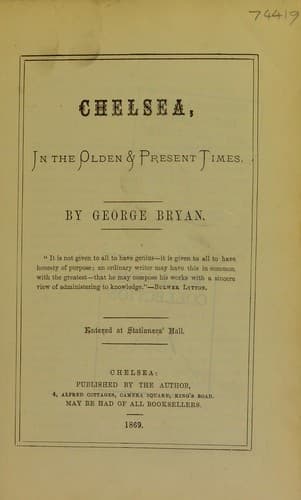
Chelsea, in the Olden & Present TimesBryan, George
History
Chelsea, in the Olden & Present Times
Bryan, George
Chelsea (London, England) -- History
Near to this house, a little to the east, about 1818, a poor man was
sitting by the roadside, apparently in the most pitiable state of hunger
and destitution. A pensioner belonging to Chelsea Hospital, a man of
colour, was passing along at the time with a can of soup and a small loaf
of bread, which he had just previously received as his dinner allowance,
some of the men being allowed to have private lodgings. The pensioner
gazed for a moment at the wretched object of misery, and then, with a
heart full of sympathy, gave him some of the soup and bread. Such an act
of benevolence excited the attention of a very young man, who, whenever
he met the kind-hearted black pensioner, always felt a feeling of respect
for him. Some time afterwards it came to the knowledge of this youth
that the pensioner had been convicted of a certain crime, not now a
capital offence, and sentenced to be executed. This communication very
much surprised him, but he could not erase from his memory the humane
conduct he had witnessed. Accordingly, he went to Newgate on the
following day, unknown to his friends, to see the condemned malefactor.
On his arrival at the prison the turnkey at the entrance door refused him
admittance, and told him, in a gruff manner, that he must get an order.
He then went direct to the Sheriff’s residence, and, after some
conversation, obtained a special order for admission. The turnkey now
became very respectful, and the young man was immediately conducted to
the yard where the condemned prisoners took the benefit of the fresh air.
The aged convict’s appearance was much altered, and during nearly the
whole time of the visit tears rolled down his cheeks. He was thus
visited several times, and, at length, through a petition presented by
the authorities at Chelsea Hospital, and another from some of the
parishioners, the unhappy black man’s sentence was mitigated to
transportation for life. At one of the interviews, the culprit asked for
some memorial of the young man’s kindness, having been previously told
that his life would be spared, and a Bible was given to him, with the
name of the youthful donor written in it. An assurance was given that he
would see him again that week, but when the young man went the poor black
pensioner had been removed from the prison, and he never heard of him
afterwards. The evidence produced at the trial fully justified the
verdict of being guilty of the charge, but there was gross culpability on
the part of the prosecutrix.
* * * * *
Public-domain text, read in full here on John Shaqi.
Reviews
Reviews
No reviews yet
Be the first to share your thoughts on this work.
Elsewhere in the archive
Join the Discussion
Join the discussion
Sign in to leave a comment or review.
Sign InorCreate an account