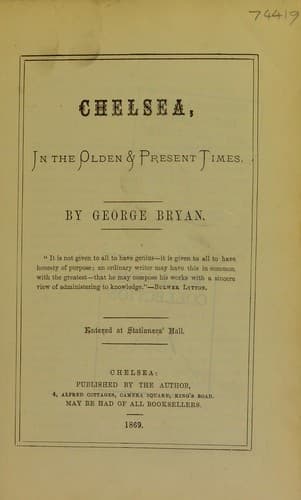
Chelsea, in the Olden & Present TimesBryan, George
History
Chelsea, in the Olden & Present Times
Bryan, George
Chelsea (London, England) -- History
A little beyond the old White Hart tea gardens, to the west, on the same
side of the road, was the residence of the elder Mr. Downing. It stood
in a neatly laid out garden, and resembled very much in appearance one of
those old but comfortable retreats which may still be seen by the
roadside in some parts of the country. Adjoining the garden was his
extensive Floor Cloth Manufactory (on the site of which is now Wellington
Square). This spacious building was situated a short distance from the
road, and the approach to it was by a carriage-way on each side, the
centre being a grass plat. In this manufactory were held most of the
earlier annual meetings of the Chelsea Auxiliary Bible Society, which
were invariably crowded. Amongst the speakers were the Rev. G. Clark,
M.A., the Rev. John Owen, M.A., the Rev. Joseph Hughes, M.A., the Rev.
John Morison, D.D., the Rev. R. H. Shepherd, the Rev. John Bunce, and
several others. Mr. Downing, sen., was a gentleman esteemed alike for
his piety and benevolence, and his sons and other branches of the family
have at all times maintained a similar respect.
* * * * *
The residence and manufactory which we have just described was pulled
down some years ago, and the present one was then erected. A deplorable
event occurred, about 38 years since, at Messrs. Downings’ new Floor
Cloth Manufactory, which it is requisite to notice in a work of this
description. A young man, whose name was Butler, the son of very worthy
parents, and who had borne a tolerably good character previous to the
fatal event we are about to mention, was convicted and executed at
Newgate, for setting fire to a portion of the premises. The fire broke
out in or near to the stables, and as it occurred on the Sunday morning,
between the hours of twelve and one o’clock, the horses were of course
locked in them. It was with great difficulty that they were rescued.
The evidence, although principally circumstantial, resulted in the jury
finding a verdict of “Guilty.” Notwithstanding the most strenuous
efforts to save the life of the young man, he suffered the extreme
penalty of the then law. A Wesleyan minister, who attended him at his
last moments, published a pamphlet stating his reasons for believing that
he was innocent. He was interred in St. Luke’s Burial Ground, and the
Church was crowded to excess.
* * * * *
On the same side of the road, and opposite Wellington Square, was
formerly the Nursery belonging to Mr. Moore. A little further westward
was the residence of Mr. Evans, sen., known as Box Farm. For many years
he lived there, and was much respected in the parish.
* * * * *
Smith Street was begun to be built in 1794, by the late Thomas Smith,
Esq., of Manor Terrace, but it was not finally; completed until about
1807.
* * * * *
Public-domain text, read in full here on John Shaqi.
Reviews
Reviews
No reviews yet
Be the first to share your thoughts on this work.
Elsewhere in the archive
Join the Discussion
Join the discussion
Sign in to leave a comment or review.
Sign InorCreate an account