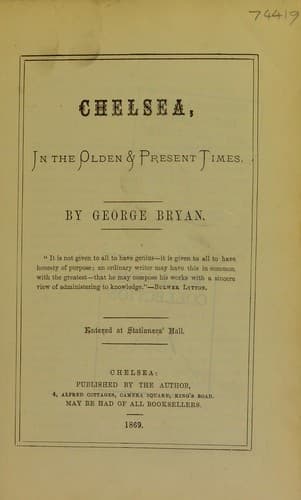
Chelsea, in the Olden & Present TimesBryan, George
History
Chelsea, in the Olden & Present Times
Bryan, George
Chelsea (London, England) -- History
* * * * *
The beautiful Duchess of Mazarin resided in Queen’s Road West, and died
there in 1699, aged 52. Her dramatic routs and musical entertainments
were celebrated for their magnificence. The singers were from the
theatres, and the instrumental performers the most eminent masters of the
time. It is said that the design of introducing the Italian Opera into
England was first concerted in this assembly. Lysons was told that it
was usual for the nobility and others who dined at her house to leave
money under their plates to pay for their entertainment. She appears to
have been in arrears for the parish rates during the whole time of her
residence at Chelsea.
* * * * *
Mrs. Mary Astell resided here the greater part of her life, which was
spent in writing for the advancement of learning, religion, and virtue.
“The good Christian,” she would say, “only hath reason to be cheerful in
this world.” She died at her house in 1731, in her 63rd year, beloved by
all who knew her, and greatly esteemed by the inhabitants.
* * * * *
Dr. Richard Mead, it appears by the parish books, resided here about
1714; he was an eminent physician. Matthew Mead, his father, was a
celebrated Nonconformist divine. Dr. Mead had a house also in Great
Ormond Street, which became a repository for all that was curious in
nature and art. He built a gallery for his pictures and antiquities,
which, when sold, produced as follows:—
57 days’ sale of books £5,518 10 11
3 ditto pictures 3,417 11 0
14 ditto prints and drawings 1,908 14 6
8 ditto coins and medals 1,977 17 0
5 ditto antiquities 3,246 15 6
The world was deprived of this distinguished physician in 1754. To the
poor he gave money as well as advice.
* * * * *
Sir Francis Windham had a house in Queen’s Road West, about 1700. He
entertained Charles II. at Trent, after the battle of Worcester, where
the king remained concealed for several days.
* * * * *
The Rev. James Miller was born in 1703. He wrote the oratorio of “Joseph
and his Brethren,” and translated and adapted to the English stage, the
“Mahomet” of Voltaire, which met with great applause; but on the third
night of its representation, being for his own benefit, he died suddenly
at his house at Chelsea, in 1743.
* * * * *
Public-domain text, read in full here on John Shaqi.
Reviews
Reviews
No reviews yet
Be the first to share your thoughts on this work.
Elsewhere in the archive
Join the Discussion
Join the discussion
Sign in to leave a comment or review.
Sign InorCreate an account