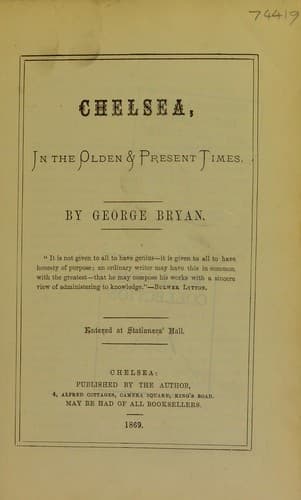
Chelsea, in the Olden & Present TimesBryan, George
History
Chelsea, in the Olden & Present Times
Bryan, George
Chelsea (London, England) -- History
Dr. Alexander Blackwell, a physician, resided in a house near the Botanic
Garden; he became involved in his circumstances, and was taken to prison
for debt. Mrs. Blackwell possessed by nature a fine genius for drawing
and painting, and being told that a Herbal was wanted, she drew from the
life several of the physical plants. These were shewn to several eminent
men, who being pleased with the undertaking she proceeded with the work,
and at length procured her husband’s liberty. She not only made the
drawings, but engraved them on copper plates, and coloured them. This
celebrated work was completed in 1739. Mr. Rand, who had the care of the
Botanic Garden, rendered her every assistance in his power.
Unfortunately Dr. Blackwell left Chelsea and went to Sweden, where he was
appointed physician to the king. Sometime afterwards, however, he was
found guilty of high treason “in plotting to overturn the constitution of
the kingdom, and sentenced to be broken alive on the wheel.” {184} It is
further said that “he prayed with great devotion; but, having laid his
head wrong, he remarked jocosely that, being his first experiment, no
wonder he should want a little instruction.” Such jocularity, at such an
awful moment, does not accord with earnest prayer.
* * * * *
The Rev. Thomas Stackhouse, a learned and pious divine, resided in
Queen’s Road West, about the year 1750; he was the author of “The History
of the Bible,” &c.
* * * * *
Mr. John Collett, the painter, resided here for a long period. The
favourite subjects of his pencil were pieces of humour, somewhat in
imitation of Hogarth. Collett died here in 1780.
* * * * *
Mr. John Giles Eccardt had a house here for some years, and died in 1779;
he was a painter of some eminence. The portrait of Gay, the poet, in
Lord Orford’s works, now almost extant, is from a painting by Eccardt.
* * * * *
Mr. W. Hamilton, a pleasing artist, resided also here for several years;
his most capital work was “The Queen of Sheba entertained at a banquet by
Solomon.”
* * * * *
Mr. Samuel Cotes lived in Queen’s Road West, where he died in 1818. He
painted miniatures both in enamel and water colours, and was in great
practice.
* * * * *
Public-domain text, read in full here on John Shaqi.
Reviews
Reviews
No reviews yet
Be the first to share your thoughts on this work.
Elsewhere in the archive
Join the Discussion
Join the discussion
Sign in to leave a comment or review.
Sign InorCreate an account