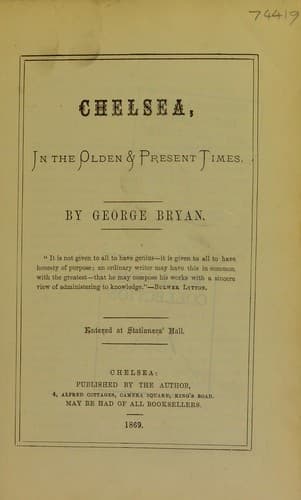
Chelsea, in the Olden & Present TimesBryan, George
History
Chelsea, in the Olden & Present Times
Bryan, George
Chelsea (London, England) -- History
1. Having, contrary to the tenor of instructions, in the summons to
Buenos Ayres, required that the civil officers and magistrates should be
prisoners.
2. Exposing the army, in marching against Buenos Ayres, to a destructive
discharge of musketry from the town.
3. Not being present personally on the advance against Buenos Ayres.
4. Surrendering the Fortress of Monte Video without necessity.
The Court, after having proceeded with the trial for several days,
allowed the General a week for his defence; and on the 24th of March, the
Secretary to H.R.H. the Commander-in-Chief communicated officially to
General Whitelocke the sentence of the Court Martial, as approved by his
Majesty, as follows:—“That the said Lieutenant-General Whitelocke be
cashiered, and declared totally unfit and unworthy to serve his Majesty
in any military capacity whatever.”
* * * * *
There have been two or three Courts of Inquiry, &c., convened at
subsequent periods, but they created nothing like the interest that was
shewn at the time of the above trial.
* * * * *
The remains of the late Duke of Wellington were laid in great state in
this hall for several days in September, 1852. Thousands of persons from
all parts of the country, as well as many distinguished foreigners, came
to witness the splendid but mournful spectacle. Such exhibitions,
however, seem rather to belong to past ages than to the present period.
* * * * *
From the Hall to the Chapel the visitor passes across a noble vestibule
lighted from above by a cupola, and which, besides serving as a
communication to both apartments, constitutes the principal entrance into
the Hospital itself. Over the altar is a fresco painting, which
represents the Resurrection of our Saviour, sublimely described in the
28th chapter of St. Matthew’s Gospel. It is the production of Sebastian
Ricci. The chapel bears the same proportions as the dining hall. It was
consecrated by Dr. Compton, Bishop of London, on the 13th of October,
1691. The service of plate, for the use of the altar, was given by King
James II.
* * * * *
The first organ was the gift of Major Ingram; but, in 1817, a new one was
placed in the original case, built by Gray, at the expense of four
hundred guineas. It contained at that time 704 pipes with 12 pedal
pipes.
* * * * *
In the chapel are deposited the standards of Tippoo Saib, the whole of
the eagles, thirteen in number, that were taken during the war with
France, &c. Both the chapel and hall must be visited to be fully
appreciated, and this remark equally applies to the different wards, the
water-garden, and indeed every part of this noble establishment.
* * * * *
Public-domain text, read in full here on John Shaqi.
Reviews
Reviews
No reviews yet
Be the first to share your thoughts on this work.
Elsewhere in the archive
Join the Discussion
Join the discussion
Sign in to leave a comment or review.
Sign InorCreate an account