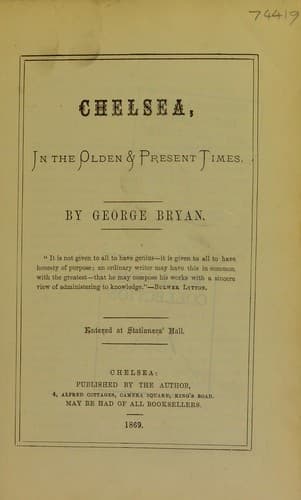
Chelsea, in the Olden & Present TimesBryan, George
History
Chelsea, in the Olden & Present Times
Bryan, George
Chelsea (London, England) -- History
Chelsea Hospital is, of course, designed to furnish an asylum for those
members of the regular army alone, whom wounds, sickness, or old age, may
have totally disabled. Its inmates are therefore, in some way or other,
invalids, that is to say, men affected by some infirmity, which, though
not visible to the eye of the common spectator, is by the patient himself
abundantly felt. For the reception of those who require admission into
it, a spacious Infirmary has been erected, where the aged patients
receive the best medical treatment and every requisite comfort.
* * * * *
Amongst the chaplains during this century may be mentioned the Rev. W.
Haggitt, M.A., the Rev. Richard Yates, D.D., the Rev. G. R. Gleig, M.A.,
and the Rev. G. Matthias, M.A., who at the present time holds the
appointment.
THE HOSPITAL BURIAL GROUND, &c.
On the east side of the Hospital, adjoining Queen’s Road East, originally
called Jews’ Row, is the cemetery, formerly used for the interment of the
officers and pensioners belonging to the establishment. Near the
entrance, on the right, is the tomb of Simon Box, the first pensioner
there buried in 1692.
* * * * *
There is a very droll epitaph in this burial ground, to the memory of
William Hiseland, which states that “when an hundred years old he took
unto him a wife.” It appears he had served in the army 80 years. He was
born in 1620, and died in 1732, so that at his decease he was 112 years
old. A literary gentleman, referring to the above marriage, exclaimed,
“Oh, the centenarian wooer and antidiluvian bridegroom—of what chronology
was his bride? Let us hope she was as silly at one end of the mortal
story, as he was in his second childhood, at the other!”
* * * * *
In this ground was buried General Sir William Fawcett, K.B., Governor of
the Hospital, who died in 1804, aged 76. His remains were attended to
the grave by the Prince of Wales, the Dukes of York, Clarence, Kent, and
Cambridge, and by several noblemen and general officers.
* * * * *
Although Dr. Monsey was not buried here, yet, as he died in the Hospital,
we must not omit to notice so remarkable a character. Sir Robert Walpole
assiduously cultivated his acquaintance, and the celebrated Earl of
Chesterfield acknowledged with gratitude the benefits he had derived from
his medical assistance.
* * * * *
Public-domain text, read in full here on John Shaqi.
Reviews
Reviews
No reviews yet
Be the first to share your thoughts on this work.
Elsewhere in the archive
Join the Discussion
Join the discussion
Sign in to leave a comment or review.
Sign InorCreate an account