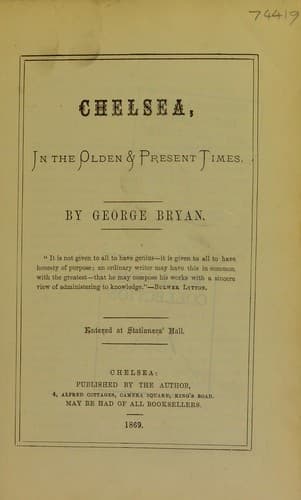
Chelsea, in the Olden & Present TimesBryan, George
History
Chelsea, in the Olden & Present Times
Bryan, George
Chelsea (London, England) -- History
The character of Dr. Monsey, in point of natural humour, is thought to
have borne a near resemblance to that of Dean Swift. His classical
abilities were indeed enviable, and his memory wonderfully retentive;
insomuch that he was allowed to be a storehouse of anecdote. The
exuberance of his wit, which, like the web of life, was of a mingled
yarn, often rendered his conversation exceedingly entertaining, sometimes
rather offensive, and at other times pointedly pathetic and instructive.
Sir Robert Walpole knew and valued the worth of his “Norfolk Doctor,” as
he called him; but though he knew it, he neglected it. The Prime
Minister was very fond of billiards, at which his friend very much
excelled him. “How happens it,” said Sir Robert, in a social hour, “that
nobody will beat me at billiards, or contradict me, but Dr. Monsey?”
“They get places,” said the Doctor, “I get a dinner and praise.”
* * * * *
The following anecdote is very characteristic of the Doctor’s turn of
temper, and is said to be well attested. He lived so long in his office
as physician to Chelsea Hospital, that, during many changes of
Administration, the reversion of his place had been successively promised
to several medical friends of the Paymaster-General of the Forces.
Looking out of his window one day, and observing a gentleman below,
examining the hospital and gardens, who he knew had secured the reversion
of his place, the Doctor came down stairs, and going out to him, accosted
him thus:—“Well, sir, I see you are examining your house and garden, that
ARE TO BE, and I will assure you they are both very pleasant and very
convenient. But I must tell you one circumstance—you are the fifth man
that has had the reversion of the place, and I have buried them all. And
what is more,” continued he, looking very scientifically at him, “there
is something in your face that tells me I shall bury you too!” The event
justified the prediction, for the gentleman died some years after; and,
what is still more extraordinary, at the time of the Doctor’s death there
was not a person who seems to have even solicited the promise of a
reversion. He died in 1788, aged 94.
* * * * *
On a table monument is an inscription to the memory of John Wilson, Esq.,
Deputy Treasurer of Chelsea Hospital, and Lieutenant-Colonel of the Royal
Volunteers. He died of apoplexy in 1812, aged 56. The monument was
erected by the officers of his regiment, as a token of their esteem.
* * * * *
Benjamin Moseley, M.D., thirty years physician to the hospital, was
buried here in 1819, aged 73.
* * * * *
General Sir David Dundas, Governor of Chelsea Hospital, was buried here
in 1820. His funeral was attended by the Duke of York, accompanied by
his Staff.
* * * * *
Public-domain text, read in full here on John Shaqi.
Reviews
Reviews
No reviews yet
Be the first to share your thoughts on this work.
Elsewhere in the archive
Join the Discussion
Join the discussion
Sign in to leave a comment or review.
Sign InorCreate an account