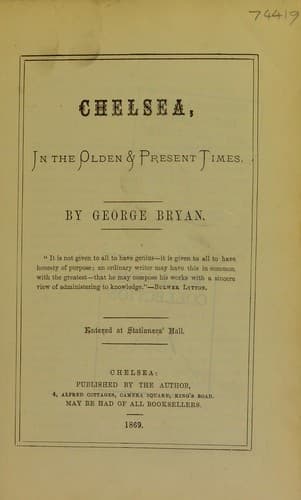
Chelsea, in the Olden & Present TimesBryan, George
History
Chelsea, in the Olden & Present Times
Bryan, George
Chelsea (London, England) -- History
Henry Warren, Esq., President of the New Society of Water Colour
Painters, resided for some time opposite St. Luke’s Church, and at a
subsequent period at the corner of Church Street, which house has been
recently pulled down.
* * * * *
From the periodical publications of the time, and from other sources, it
appears the following persons have resided in this parish at various
periods:—
Robert Ratcliffe, the first Earl of Sussex of that family, and Lord High
Chamberlain of England, died at his palace at Chelsea, November 26, 1542.
Robert Viscount Fitzwalter was created Earl of Sussex by Henry VIII. in
1527. He married first, Elizabeth, daughter of Edward Stafford, Duke of
Buckingham; secondly, Margaret, daughter of Thomas, Earl of Derby;
thirdly, Mary, daughter of Sir John Arundel.
* * * * *
John Pym, a distinguished Member of the House of Commons, resided at
Chelsea for several years. {218} He was Member for Tavistock, and was a
remarkable instance of what wonders, strength of parts, and force of
eloquence, could effect. His influence was superior to authority, but by
many he was thought to have made a very bad use of power; his intent was
to reform, not to abolish the Government; and yet he was a principal
engine in bringing about a revolution, which he never intended, and which
he did not live to see; he died December 8, 1643. His excessive
application to public affairs is supposed to have hastened his death.
“He was a man,” says Hume, “as much hated by one party as respected by
the other. At London, he was considered as the victim of national
liberty, who had abridged his life by incessant labours for the interest
of his country. At Oxford, he was believed to have been struck with an
uncommon disease, and to have been consumed with vermin, as a mark of
Divine vengeance for his multiplied crimes and treasons. He had been so
little studious of improving his private fortune in those civil wars, of
which he had been one principal author, that the Parliament thought
themselves obliged from gratitude to pay the debts which he had
contracted.”
* * * * *
Count D’Estrades, who came to England to negociate the sale of Dunkirk,
as ambassador from Lewis XIV., resided at Chelsea during the years 1661
and 1662. This fact appears by the dates of his letters, of which a
translation appeared in 1755. He had his first audience of his Majesty
King Charles II. on the 27th of July of the former year. It was usual
for the Foreign Ambassadors at that time to make their public entry from
the Tower of London, but on this occasion the King sent his own coaches
to Chelsea, to carry the Ambassador, and the Count was accompanied by the
equipages of the whole of the diplomatic corps at that time in London.
Public-domain text, read in full here on John Shaqi.
Reviews
Reviews
No reviews yet
Be the first to share your thoughts on this work.
Elsewhere in the archive
Join the Discussion
Join the discussion
Sign in to leave a comment or review.
Sign InorCreate an account