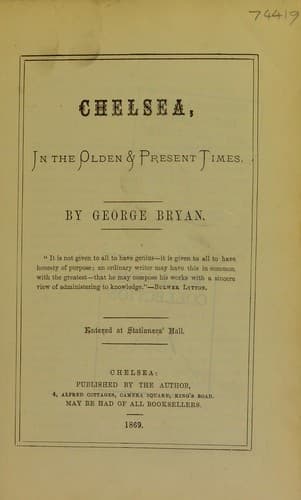
Chelsea, in the Olden & Present TimesBryan, George
History
Chelsea, in the Olden & Present Times
Bryan, George
Chelsea (London, England) -- History
Count D’Estrades was invited by letters from the Chancellor himself, in
order to conclude the bargain; £900,000 were demanded, £100,000 were
offered. By degrees the English lowered their demands, and the French
raised their offers. The bargain was concluded at £400,000.
* * * * *
Sir Robert Atkyns, either Chief Baron of the Exchequer, or his son, the
historian of Gloucestershire, appears by the Parish Books to have resided
in Chelsea in 1684.
Sir Robert Atkyns, K.B., was Lord Chief Baron of the Exchequer under
William III., which office he held with distinguished ability and
integrity. This gentleman, by his influence, promoted the Revolution,
and by his pen defended it in tracts replete with legal knowledge.
* * * * *
The Hon. Colonel Rieutort died at his house, Chelsea, on the 24th
January, 1725–6, in his 66th year. He was born of a good family, at
Montpelier, in France, where he early bore arms; and, having left his
native country, on account of the Protestant religion, he attended
William III. in the wars of Ireland. He afterwards served the Crown of
Great Britain in Piedmont; and in 1703 assisted Count de Frise in the
vigorous defence of Landau, then besieged by the French. In 1704, he
went into Portugal with the Earl of Galway, who sent him to the relief of
the Prince of Hesse, then closely beset in Gibraltar, where he
contributed very much to the preservation of that important place. He
was interred in Chelsea Church.
THE CANCER HOSPITAL.
This hospital is situated in the Fulham Road, almost facing the
Consumption Hospital. The ceremony of laying the foundation stone was
performed on Monday, May 30, 1859, by Miss Burdett Coutts, in the
presence of a very numerous and respectable company, including Dr. Tait,
Bishop of London, Archdeacon Sinclair, Rev. D. Coleridge, Rev. J. B.
Owen, the Rev. Fathers Ballard and Bagshawe, Priests of the Oratory, at
Brompton, &c.
* * * * *
The Rev. Thomas Pearson commenced the proceedings with prayer, after
which the Bishop of London addressed the assemblage, and said they were
met to lay the foundation stone of a most excellent institution, destined
to bestow great blessings on a large portion of the community—a house for
the reception of persons afflicted with a most painful disease, demanding
the greatest sympathy from all friends of humanity. His Lordship, at the
close of his address, prayed for its permanency and success.
* * * * *
Miss Coutts having deposited the bottle, with the usual contents, in a
cavity in the lower stone and spread the mortar, the upper stone was duly
lowered into its place, after which Miss Coutts gave the customary knocks
and declared the stone duly laid.
* * * * *
Public-domain text, read in full here on John Shaqi.
Reviews
Reviews
No reviews yet
Be the first to share your thoughts on this work.
Elsewhere in the archive
Join the Discussion
Join the discussion
Sign in to leave a comment or review.
Sign InorCreate an account