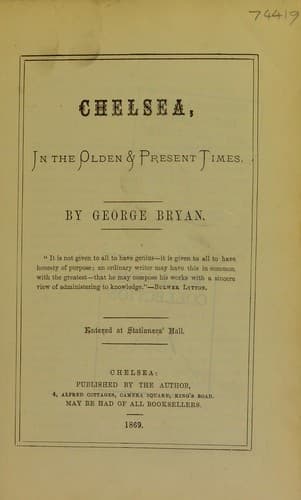
Chelsea, in the Olden & Present TimesBryan, George
History
Chelsea, in the Olden & Present Times
Bryan, George
Chelsea (London, England) -- History
Jane, Duchess of Northumberland, was a most singular instance of the
vicissitudes of fortune, having been the wife of one of the greatest men
of that age, she lived to see her husband lose his head on a scaffold; to
see one son share his father’s fate, another die in a prison, and the
rest of her children live only by permission. Amidst this accumulated
distress, which was heightened by the confiscation of her property, she
displayed great firmness of mind, though left destitute of fortune and
friends, till the arrival of some of the Spanish nobility, who interested
themselves so warmly in her favour, that they prevailed on the Queen to
reinstate her in some of her former possessions. She made a will,
written with her own hand, unassisted by the advice of any learned in the
laws. Amongst a variety of other bequests, she left to Sir Henry Sidney
the gold and green hangings in the manor house, “water side, at Chelsey.”
“My will,” she says, “is earnestly and effectually, that little
solemnities be made for me, for I had even have a thousand foldes my
debts to be paide, and the poore to be given unto, than anye pompe to be
shewed upon my wretched carkes; therefore to the wormes will I goe, as I
have afore wrytten in all poyntes, as you will answer yt afore God; and
you breke any one jot of it, your wills hereafter may chaunce be as well
broken.” Notwithstanding the strict injunctions contained in her will,
she was buried with great funeral pomp, in February, 1535; two heralds
attending, with many mourners, six dozen of torches, and two white
branches, and “a canopy borne over her effigies in wax, in a goodly
hearse to the church of Chelsey.”
* * * * *
Ann of Cleves, after her divorce from Henry VIII., appears to have
resided in this manor house, where, it is said, she died in 1557, and was
buried in Westminster.
* * * * *
Queen Elizabeth, in 1559, leased this manor to Ann, Duchess of Somerset,
widow of the late Protector, for life. Her Majesty afterwards granted
the manor to John Stanhope, Esq., vice-chamberlain of her household. On
the accession of James I. he was created Lord Stanhope, of Harrington.
After several families had held the manor, we find it in possession of
the Cheyne family.
* * * * *
Public-domain text, read in full here on John Shaqi.
Reviews
Reviews
No reviews yet
Be the first to share your thoughts on this work.
Join the Discussion
Join the discussion
Sign in to leave a comment or review.
Sign InorCreate an account